WhatsApp Marketing Strategy: How to Generate More Leads and Sales
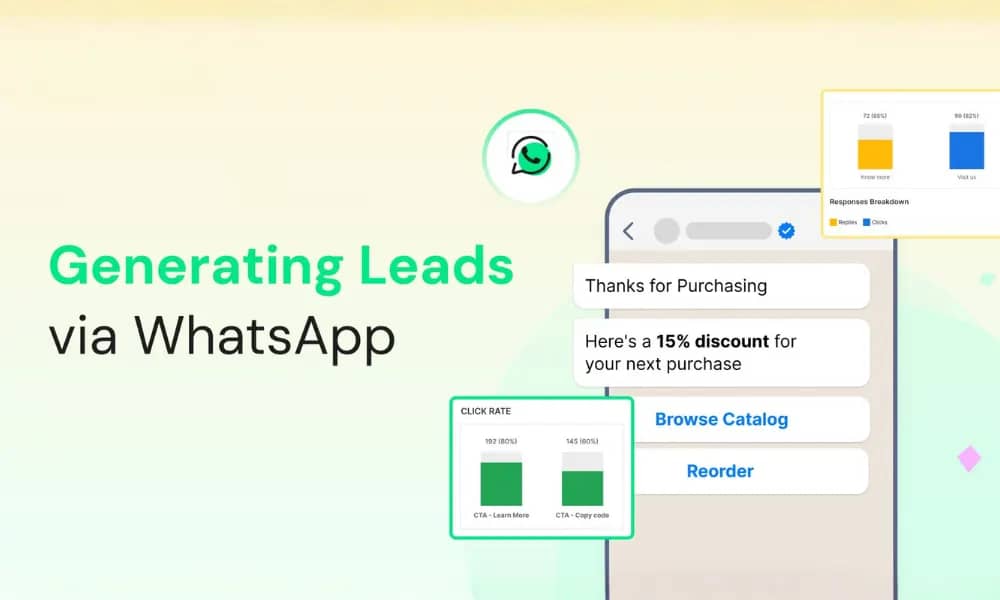
For many businesses, WhatsApp is still treated like a customer-support inbox.
A customer messages. Someone replies. Conversation over.
That leaves a lot of value on the table.
A well-designed WhatsApp marketing strategy can connect advertising, lead capture, qualification, sales, payments, follow-ups and customer retention inside the same conversation.
And in markets such as India and the UAE, that matters because WhatsApp is already part of everyday customer behavior rather than another app businesses need to persuade people to use.
The opportunity is not simply sending more WhatsApp messages.
It is building a better sales system around the conversations customers already want to have.
Quick answer: What is a WhatsApp marketing strategy?
A WhatsApp marketing strategy is a structured plan for using WhatsApp to attract, qualify, convert and retain customers. It can combine Click-to-WhatsApp ads, automated lead qualification, catalogs, CRM integrations, approved marketing messages and human sales conversations. The strongest strategies focus on consent, fast responses and measurable movement from conversation to revenue.
Why WhatsApp Marketing Works
WhatsApp marketing is often sold using two statistics:
98% open rates. 45 to 60% conversion rates.
You will find those numbers on hundreds of marketing websites.
You should not build your business case around them.
A 2026 benchmark from WhatsApp marketing provider Chatarmin analysed 49.3 million campaign messages across 382 brands. It reported a 79% weighted open rate across 13.9 million measured campaign messages from March to May 2026 and an 11.8% click rate using its stated methodology.
The same report explicitly describes the frequently repeated 98% open-rate figure as unsupported by a reliable source.
A 79% measured open rate is less sensational than 98%. It is also considerably more useful.
The case for WhatsApp does not need exaggerated statistics.
The bigger advantage is conversational intent
Email is primarily an inbox. WhatsApp is a conversation. That changes user behavior.
Someone who clicks an ad and arrives on a landing page still has several steps ahead:
Ad → page → read → form → submit → wait for response
Click-to-WhatsApp can compress that journey:
Ad → conversation
The customer can immediately ask:
- How much does this cost?
- Is it available today?
- Do you deliver to my area?
- Can I book Saturday?
- Which plan is right for me?
- Do you have this in another size?
Your business can answer, qualify and progress the sale while the customer’s intent is still active.
That is the real advantage.
Meta’s India data shows the commercial potential
In February 2026, Meta and the Retailers Association of India published research showing substantial results from conversational commerce.
According to Meta, Indian retailers using Business Messaging and Click-to-WhatsApp campaigns saw, on average:
- 62% more leads
- 61% improvement in return on ad spend
- 22% higher order values
Meta also reported that 72% of product discovery in the study occurred on WhatsApp.
These are Meta-reported figures and should not be treated as guaranteed outcomes for every business.
But they demonstrate why WhatsApp deserves to be evaluated as a revenue channel rather than merely a support tool.
A real banking example
Banco Mercantil provides an even more concrete example.
The Brazilian financial-services company integrated ads that click to WhatsApp, WhatsApp Business Platform and marketing, utility and service messaging into its customer journey.
Across performance measured from June 2024 to June 2025, the bank reported:
- 51% of customers who started a WhatsApp conversation acquired at least one credit product
- marketing messages converted at 33%, 11 times its reported SMS conversion rate
- 40% of sales were attributed to WhatsApp
The results were self-reported by the company, so they should not be interpreted as universal benchmarks.
But they illustrate the strategic point.
WhatsApp works best when it is connected to the entire buying journey.
Not when it is used as a broadcast list.
WhatsApp Business App vs. WhatsApp Business Platform: Which Do You Need?
This is where a lot of WhatsApp marketing articles become unnecessarily confusing.
There are essentially three ways to think about your setup.
| Option | Best for | Typical volume | Automation | Setup complexity |
| WhatsApp Business App | Solo operators and small businesses managing conversations manually | Low to moderate | Basic/native features | Low |
| WhatsApp Business Platform through a provider | Growing businesses running campaigns, automation and multi-agent sales/support | Moderate to high | Strong | Medium |
| Cloud API / Business Platform direct | Technical teams building custom WhatsApp infrastructure | High/custom | Fully customizable | High |
WhatsApp Business App
The WhatsApp Business App is usually enough for businesses where one person or a small team handles conversations directly.
Examples include:
- salon
- consultant
- local retailer
- independent real-estate agent
- clinic
- home-service provider
- small restaurant
The app provides business features while remaining relatively simple to manage.
Meta describes the Business App as its option for smaller businesses handling customer conversations personally, while positioning the WhatsApp Business Platform for businesses requiring programmatic communication at scale.
And the gap between the products is narrowing.
In India, Meta introduced Business AI for eligible small businesses in 2026, allowing businesses to automate customer responses, capture leads, book appointments and recommend products inside the Business App without requiring separate coding or third-party software.
So do not assume every form of automation automatically requires the API.
WhatsApp Business Platform through a provider
Once WhatsApp becomes part of a serious acquisition or sales system, the Platform usually makes more sense.
This is often called the WhatsApp Business API, although technically the current product is the WhatsApp Business Platform and its APIs include Meta’s Cloud API.
A Business Solution Provider or software platform can put an easier interface around the infrastructure.
Depending on the provider, that can give your team:
- shared inboxes
- multiple agents
- broadcasts
- approved message templates
- automated workflows
- chatbots
- lead routing
- CRM connections
- campaign reporting
- ecommerce integrations
Providers include platforms such as AiSensy, Gallabox and numerous others.
The important decision is not which logo appears on the dashboard.
Ask: What business process are we trying to automate?
Choose the infrastructure after that.
Cloud API direct
Meta also hosts the Cloud API itself.
This route makes sense when your company has developers and wants deeper control over its infrastructure.
Your team might directly connect WhatsApp with:
- proprietary CRM
- ecommerce backend
- inventory database
- AI agent
- lead-scoring system
- customer-data platform
- internal analytics
You gain flexibility. You also take responsibility for considerably more implementation work.
For most small businesses, building directly on the API is unnecessary.
You may not have to choose only one anymore
There is another recent change worth knowing.
In September 2025, Meta announced that eligible small businesses could use the WhatsApp Business App and WhatsApp Business Platform simultaneously with the same phone number.
That gives growing businesses more flexibility.
The practical decision is therefore increasingly about capabilities rather than an all-or-nothing migration.
Building Your WhatsApp Lead Funnel
A strong WhatsApp lead generation strategy maps the complete customer journey.
Think in five stages:
Attention → conversation → qualification → conversion → retention
1. Awareness: Use Click-to-WhatsApp Ads
One of the most powerful acquisition routes is an ad campaign that opens a WhatsApp conversation directly.
A customer sees an Instagram or Facebook ad. Instead of clicking through to a website, they tap and enter a WhatsApp chat with your business.
This works particularly well where the buyer wants to ask something before converting.
Examples:
Real estate
“Interested in 2 and 3 BHK apartments in Gurgaon? Message us for current availability and floor plans.”
Education
“Not sure which digital-marketing course suits you? Chat with an advisor.”
Healthcare
“Ask about appointment availability.”
Automotive
“Check this week’s offers and book a test drive on WhatsApp.”
D2C
“Need help choosing your shade? Ask us on WhatsApp.”
Meta has invested significantly in Click-to-Message adoption in India. In 2025 it launched an agency programme specifically to help thousands of Indian agencies and SMBs use click-to-message advertising. Meta also reported that WhatsApp Cloud API was already powering 70,000 Indian businesses each month at that point.
The ad is only step one.
The important part is what happens after the click.
2. Capture: Reduce unnecessary form friction
Suppose someone sees your real-estate advertisement.
Traditional funnel:
Ad → Landing page → Form → Name → Phone → Email → Budget → Submit → CRM → Salesperson calls later
A conversational funnel can start immediately:
Ad → WhatsApp → “Hi, I’m interested in the project.” → “Great. Are you looking for a 2 BHK or 3 BHK?” → “3 BHK.” → “What budget range are you considering?”
You are collecting much of the same information.
But it feels like a conversation rather than administration.
WhatsApp also supports structured interactive experiences, allowing businesses to collect information within the messaging journey rather than forcing every user onto an external page.
Use this carefully.
Do not ask ten questions simply because automation makes ten questions possible.
Collect only what you need to move the lead forward.
3. Qualification: Automate the repetitive part, not the relationship
Not every WhatsApp lead deserves immediate human attention.
A qualification flow might ask:
- What service are you interested in?
- What is your approximate budget?
- When do you need it?
- Where are you located?
- Would you like to speak with an advisor?
The answers can be used to route leads.
For example:
Hot lead – Budget fits + immediate requirement + relevant geography → sales rep immediately
Warm lead – Budget fits + later requirement → CRM nurture sequence
Poor fit – Outside service area → polite automated response or alternative resource
The goal of automation is not to prevent customers from reaching people.
It is to prevent salespeople spending all day asking repetitive qualification questions.
Meta’s policies explicitly allow automation, but businesses using automated responses must provide a clear route to escalate to human support where required.
A chatbot that traps the customer is not good automation.
4. Conversion: Make buying easier inside the conversation
Once someone is qualified, do not suddenly force them through unnecessary friction.
Move the sale forward while the conversation is active.
Depending on the business, that could include:
- product catalog
- product images
- availability
- quotation
- consultation booking
- appointment selection
- payment link
- store location
- financing options
- delivery information
- human sales handover
For ecommerce, WhatsApp can also recover buying journeys that would otherwise disappear.
For example:
Customer abandons cart. → Approved follow-up message. → “Still interested in the blue linen shirt? Your size is currently available.” → The customer responds. → Agent or automation answers sizing questions. → Purchase.
That is much more conversational than another generic “You left something behind” email.
5. Retention: Use WhatsApp after the sale
Customer acquisition gets most of the attention.
Retention often produces easier wins.
Useful post-purchase WhatsApp communication can include:
- order confirmations
- shipping updates
- appointment reminders
- renewal reminders
- refill reminders
- service reminders
- review requests
- relevant product recommendations
- replenishment messages
- win-back campaigns
The word relevant is important.
Buying from you once is not permission to send a promotion every three days forever.
Your retention strategy should increase customer value without making the inbox irritating.
Build Trust and Compliance Into the Strategy
WhatsApp is unusually personal.
That is why it performs well.
It is also why bad marketing feels especially intrusive.
Email spam sits beside dozens of newsletters.
WhatsApp spam appears beside messages from friends, family and colleagues.
Treat access to that inbox accordingly.
You need opt-in
WhatsApp’s business policy is clear.
A business can contact someone on WhatsApp only when:
- the person has provided their mobile number, and
- the business has received opt-in permission confirming that the person wants subsequent WhatsApp messages.
WhatsApp says the opt-in should clearly identify WhatsApp as the messaging channel and identify the business.
Do not buy a phone-number database and upload it into a WhatsApp marketing tool.
Do not assume that because someone gave you their number for delivery, they automatically agreed to promotional WhatsApp messages.
Build consent deliberately.
You can collect opt-ins through:
- website forms
- checkout
- lead forms
- Click-to-WhatsApp ads
- QR codes
- store signage
- account registration
- events
- customer-service conversations
Make the expected communication clear.
“Get updates on WhatsApp” is weaker than:
“Send me order updates and occasional product offers on WhatsApp.”
Understand the 24-hour customer-service window
When a user messages your business, the WhatsApp Business Platform provides a customer-service window in which you can respond without using a template.
Outside that window, business-initiated messages generally require approved templates under WhatsApp’s platform rules.
This distinction matters when building automation.
Your sales workflow should know:
- who initiated the conversation
- when the last customer message arrived
- whether a template is required
- what type of template is appropriate
Do not leave this logic to individual salespeople.
Build it into the system.
Marketing, utility and service messages are not the same thing
A discount campaign and a delivery update serve different purposes.
Treat them differently.
A useful practical distinction is:
Marketing – Promotions, offers, recommendations, cross-sells and re-engagement.
Utility – Transactional information relating to something the customer has already done, such as an order or account interaction.
Service – Responses occurring within an active customer-service conversation.
WhatsApp reviews business-initiated templates and can restrict businesses that repeatedly send low-quality or policy-violating messages. Meta has also introduced limits designed to reduce the number of marketing messages users receive.
That makes relevance part of deliverability.
Not merely good copywriting.
India: understand the DPDP transition
Indian businesses also need to plan around the Digital Personal Data Protection Act, 2023 and the final Digital Personal Data Protection Rules, 2025.
The final Rules were notified in November 2025, but implementation is phased.
The government notification states that many of the central provisions covering consent, notices, data-principal rights and related processing requirements come into force 18 months after the November 13, 2025 notification, rather than all becoming operative immediately.
That distinction matters in September 2026.
Businesses should not inaccurately describe every DPDP consent provision as already fully in force.
But they should be preparing now.
The Act’s consent framework requires consent, where relied upon, to be free, specific, informed, unconditional and unambiguous, with clear affirmative action. It also provides for withdrawal of consent with comparable ease.
For WhatsApp marketing teams, the practical direction is straightforward:
- record where consent came from
- record what the person agreed to
- separate operational consent from marketing consent where appropriate
- make unsubscribe/withdrawal easy
- stop marketing when consent is withdrawn
- avoid collecting unnecessary personal data
- align your CRM, WhatsApp provider and other processors around the same consent state
This is a marketing operations issue, not something to leave exclusively with legal after the system has already been built.
Watch your block and complaint rates
One of the worst WhatsApp KPIs is also one of the most useful:
How many people want you gone?
Meta allows users to block and report businesses and evaluates message quality. Businesses that repeatedly violate policies can face increasingly serious messaging restrictions.
If block rates increase, do not immediately blame the creative.
Ask:
- Did users genuinely opt in?
- Are we sending too frequently?
- Is the message relevant?
- Are we segmenting properly?
- Is the value obvious?
- Are we making it easy to stop messages?
Compliance and performance often point in the same direction.
Send better messages to fewer, more relevant people.
WhatsApp CRM Integration: Don’t Let Leads Die in the Inbox
Generating more WhatsApp leads creates another problem.
You now have more WhatsApp leads.
If every conversation lives only inside a messaging dashboard, sales management becomes difficult.
A prospect might ask for a quotation on Monday. Speak to another agent on Thursday. Return three weeks later.
Without CRM integration, the new agent may have no idea:
- which campaign generated the lead
- what product they wanted
- their budget
- previous objections
- quotation sent
- next follow-up date
- sales stage
- revenue potential
That is how good leads disappear.
What a useful WhatsApp CRM integration should do
A good integration should capture meaningful sales context automatically.
For example:
Lead source: Instagram Click-to-WhatsApp ad
Campaign: Dubai Villas Q3
Interest: 3-bedroom property
Budget: AED 2.5M to AED 3M
Timeline: Within 90 days
Owner: Sales Rep A
Stage: Qualified
Last contact: September 2
Next action: September 4
Now WhatsApp is not simply an inbox.
It is an input into your sales system.
CRMs such as HubSpot, Zoho, Salesforce and Pipedrive can form part of this architecture depending on your setup and integration layer.
The brand of CRM matters less than the data flow.
The important rule is: every commercially meaningful WhatsApp conversation should leave useful information behind.
What This Means for Businesses in India and MENA
WhatsApp strategy depends heavily on geography.
In some countries, business messaging remains supplementary.
Across India and parts of the Middle East, it can sit much closer to the centre of customer communication.
India: WhatsApp is infrastructure
India is WhatsApp’s largest market.
Current estimates vary depending on methodology. Reuters reported roughly 500 million users in India in July 2026, while other industry estimates run considerably higher. What is not in dispute is India’s position as WhatsApp’s largest national market.
More importantly for marketers, businesses are already using it operationally.
Meta says millions of Indian small businesses use the WhatsApp Business App, while tens of thousands use Cloud API every month.
For an Indian:
- D2C brand
- real-estate company
- education business
- clinic
- financial-services company
- automotive dealership
- travel company
- local retailer
telling customers to “check your email” may add friction.
WhatsApp often feels more natural.
That does not mean replacing email entirely.
Use each channel according to what customers actually do.
UAE and MENA: messaging can be closer to the sale
WhatsApp is also deeply embedded in communication in the UAE.
Data published in 2026 based on an October 2025 survey identified WhatsApp as the most widely used social platform among surveyed UAE internet users aged 16 to 64.
For many MENA businesses, that makes conversational selling especially relevant.
A real-estate prospect may expect: brochure, floor plan, price, availability, viewing time – inside WhatsApp.
A clinic prospect may want: doctor availability, appointment time, location, price – inside WhatsApp.
A luxury retailer may send: product images, availability, alternatives, payment instructions – inside the conversation.
Your marketing strategy should reflect the customer’s preferred buying behavior rather than importing a Western email-first funnel without questioning it.
Measuring WhatsApp Marketing Performance
Do not judge WhatsApp by open rate alone.
A message can be opened and commercially useless.
Measure movement through the funnel.
Response rate – What percentage of delivered conversations generate a meaningful customer response? Useful for sales, re-engagement and qualification campaigns.
Lead qualification rate – What percentage of WhatsApp leads meet your sales criteria? This is especially important for Click-to-WhatsApp campaigns. Cheap conversations are not automatically cheap leads.
Cost per qualified lead – Ad spend + messaging/infrastructure cost ÷ qualified leads. This is usually more useful than cost per initiated chat.
Conversion rate – What percentage of qualified WhatsApp leads become customers? Define the denominator clearly. “45% WhatsApp conversion rate” means nothing unless you know whether that means message → click, click → lead, lead → sale, or qualified lead → sale.
Conversion velocity – Measure how long it takes to move from first WhatsApp conversation to qualified lead, booked appointment, order, payment. One of WhatsApp’s advantages can be speed. Measure it.
Revenue per conversation – For commerce-oriented campaigns: how much attributable revenue does each initiated or qualified conversation generate? This helps compare WhatsApp with other channels.
Block and opt-out rate – Track them aggressively. A campaign that generates revenue while destroying future inbox access is not necessarily successful.
Sales-response time – How quickly does a qualified lead reach a human when one is needed? Five minutes versus five hours can materially affect conversion. Automation should make this faster. Not create another queue.
A Simple WhatsApp Marketing Strategy to Start With
You do not need 30 automations on day one.
Start with one customer journey.
For example:
Step 1: Acquisition – Run a Click-to-WhatsApp advertisement around one clear offer.
Step 2: Qualification – Ask three to five questions that determine whether the lead fits.
Step 3: CRM – Automatically create or update the contact.
Step 4: Routing – Send qualified leads to the appropriate salesperson.
Step 5: Conversion – Give the salesperson the context, assets and offers needed to close inside the conversation.
Step 6: Follow-up – Trigger an appropriate follow-up if the lead does not convert.
Step 7: Measurement – Track cost per qualified lead, qualified-lead-to-sale conversion and response speed.
Make one funnel work. Then expand.
The biggest mistake is automating ten bad processes simultaneously.
Frequently Asked Questions
WhatsApp marketing costs depend on your country, message type, volume and setup. Businesses using the WhatsApp Business Platform may pay Meta messaging charges plus fees from a Business Solution Provider, CRM or automation platform. Click-to-WhatsApp advertising also carries normal Meta advertising costs. Check current Meta and provider pricing before forecasting a campaign because rates and pricing structures can change.
Businesses should not send proactive WhatsApp marketing simply because they possess someone’s phone number. WhatsApp requires businesses to obtain opt-in from people they contact, and its policy says the opt-in should make clear that messages will arrive through WhatsApp and identify the business sending them.
WhatsApp marketing describes the strategy of using WhatsApp to acquire, nurture, convert and retain customers. The WhatsApp Business App is one tool for doing that, mainly designed around smaller businesses managing customer conversations. Businesses requiring larger-scale automation, integrations and programmatic messaging can use the WhatsApp Business Platform.
Businesses can use the WhatsApp Business Platform either through an approved technology/provider ecosystem or by building more directly using Meta’s Cloud API and associated infrastructure. The right route depends on whether you want a ready-made inbox and automation platform or have the technical resources to build your own integration.
Not always. The WhatsApp Business Platform provides far greater automation and integration capabilities, but Meta has also introduced more automation directly within the Business App, including Business AI for eligible Indian small businesses in 2026. Choose based on the workflow you need rather than assuming every chatbot requires a custom API implementation.