What Is SEO? Meaning, Types and How It Works (2026 Guide)
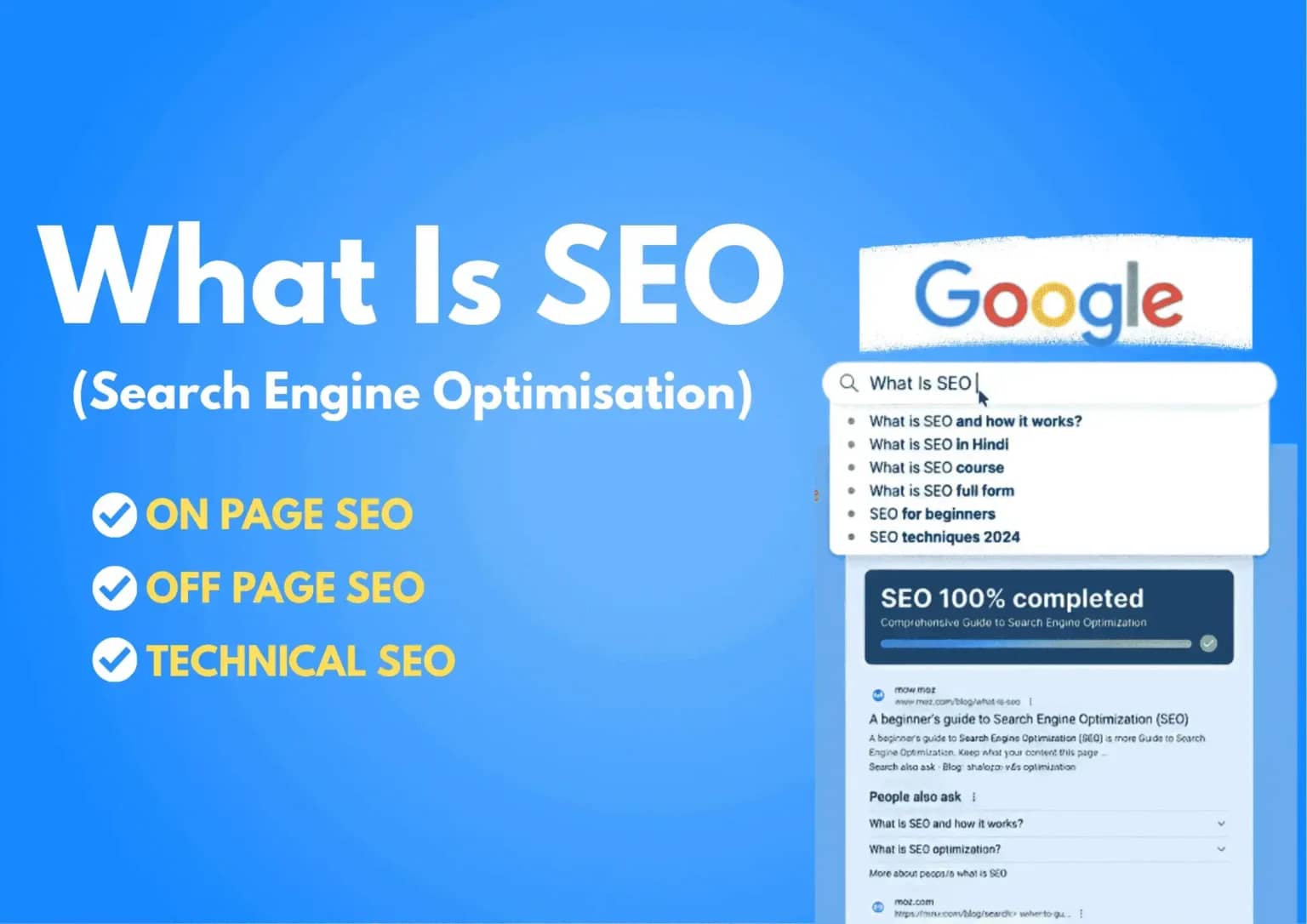
SEO stands for Search Engine Optimisation. It is the practice of improving a website so it ranks higher in unpaid (organic) search results on Google and Bing, and gets cited in AI answers like Google’s AI Overviews and ChatGPT search. It covers your content, your site’s technical health and your reputation across the web.
If you’ve ever searched “SEO kya hai” or “SEO full form” and got a page full of jargon, this guide is the plain version.
Here’s the idea in one picture. A family in Jaipur types “dentist near Malviya Nagar” at 10pm because a tooth has started throbbing. Google shows them a map, a few clinic websites and maybe an AI summary. Whoever appears there gets the call. SEO is everything a clinic does so that it’s one of those names, without paying Google for the spot.
The same logic applies to a D2C skincare brand, a CA firm in Noida, a school in Pune or an NGO in Delhi. In this guide we’ll cover what SEO means, how Google decides what to show, the main types of SEO, what’s changed with AI Overviews and AI Mode, and the exact steps to start.
SEO at a glance
How SEO works: search engines send automated crawlers to discover pages, store them in an index, and rank them for each search based on relevance, quality and authority. SEO is how you show Google that your page is the best answer to that search.
The main types of SEO:
- On-page SEO: making the content, headings, title tags and internal links on each page useful and clearly matched to what people search.
- Technical SEO: making sure search engines can crawl and index your site, which covers speed, mobile usability, HTTPS, sitemaps and clean code.
- Off-page SEO: building authority outside your site through backlinks from reputable websites, brand mentions and reviews.
- Local SEO: getting found in “near me” and city searches through your Google Business Profile, reviews and location pages.
Why SEO matters:
- No cost per click. Organic visitors arrive without you paying for each click, unlike Google Ads.
- Trust. People see organic listings as earned rather than bought, and AI answers quote organic pages, not ads.
- Results that last. Ads stop the day the budget stops. A page that ranks keeps bringing visitors for months or years.
- Visibility in AI search. The same work decides whether Google’s AI Overviews, AI Mode and ChatGPT name your business when they answer.
The rest of this guide explains each of these in detail, with examples from Indian businesses.
What does SEO stand for?
SEO stands for Search Engine Optimisation (spelt “optimization” in US English). Search engines are tools like Google and Bing. Optimisation means making changes that get better results. Put together, SEO means improving your site so that it earns more visibility in organic search results, the unpaid listings below or around the ads.
Google’s own definition is close to that. Its SEO Starter Guide says SEO is “about helping search engines understand your content, and helping users find your site.”
What is organic traffic?
Organic traffic is anyone who reaches your site by clicking an unpaid search result. If someone searches “best laptop for college students under ₹50,000”, finds your comparison article and clicks it, that’s an organic visit. You don’t pay Google per click, but you do pay in time, content and expertise to earn the position.
How does SEO work?
SEO works by helping search engines do four jobs well. Their crawlers find your page, render it, store it in an index, and then rank it against every other page based on relevance and authority when someone searches. Here’s what happens at each stage.
- Crawling. Google’s crawler, Googlebot, discovers pages by following links and reading sitemaps. If nothing links to a page and it isn’t in your sitemap, Google may never find it.
- Rendering. Google loads the page much like a browser would, including its code, to see what a visitor actually sees. Content hidden behind broken scripts can get missed here.
- Indexing. Google analyses the page and decides whether to store it in its index, which is essentially a giant library of web pages. Duplicate or very thin pages often don’t make it in.
- Ranking (serving). When someone searches, Google pulls the most relevant pages from its index and orders them using hundreds of signals, from how well the page answers the question to the searcher’s location and language.
Notice that a page has to pass all three earlier stages before it can rank at all. A surprising number of “why don’t I rank?” problems we see are actually stage 1 or 3 problems, like a page accidentally set to noindex or orphaned with no internal links pointing to it.
As for shortcuts, Google is blunt. Its Starter Guide says, “There are no secrets here that’ll automatically rank your site first in Google (sorry!).” Anyone promising a guaranteed #1 ranking is selling something Google itself won’t promise.
What does Google look for when ranking a page?
Google’s ranking systems mostly try to answer one question: which page best satisfies this person, right now? In practice that comes down to a handful of things.
- Intent match. Someone searching “how to bake chocolate cake” wants a recipe, not a bakery’s homepage.
- Helpfulness and accuracy. Content written to genuinely help, ideally by someone with real experience.
- Trust signals. Who wrote it, whether other reputable sites reference you, and whether your business information is consistent.
- Usability. The page loads properly on a ₹10,000 Android phone on a 4G connection, not just on your office laptop.
- Context. The searcher’s location, language and device.
What are the main types of SEO?
There are three core types of SEO, on-page, off-page and technical, plus specialised areas like local, content and e-commerce SEO that borrow from all three. Most businesses need some of each, but in different proportions.
| Type of SEO | What it covers | Who leans on it most |
| On-page SEO | Content, titles, headings, internal links, image alt text, URLs | Every website |
| Off-page SEO | Backlinks, brand mentions, PR, reviews on other sites | Brands in competitive categories |
| Technical SEO | Crawlability, indexing, site speed, mobile usability, HTTPS, schema | Large sites, e-commerce, sites after a redesign |
| Local SEO | Google Business Profile, local pages, reviews, map rankings | Clinics, restaurants, salons, coaching centres, service businesses |
| Content SEO | Keyword research, topic clusters, updating old posts | Blogs, publishers, B2B, NGOs |
| E-commerce SEO | Product and category pages, filters, duplicate URLs, product schema | Online stores and D2C brands |
On-page SEO
On-page SEO is everything you control on the page itself. A product page titled “Our Latest Collection” tells Google and searchers nothing. “Men’s Running Shoes Under ₹3,000 | Free Returns” tells both of them exactly what’s inside. Good on-page work means clear titles, honest headings, useful content and sensible on-page SEO basics like internal links and descriptive image alt text.
Off-page SEO
Off-page SEO is about your reputation outside your own site. The best-known part is backlinks, which are links from other websites to yours. A mention in Economic Times or a respected industry blog carries far more weight than fifty links from directories nobody reads. Buying links to game rankings breaks Google’s spam policies, and it’s the classic black-hat SEO mistake.
Brand mentions matter more than most people realise. An Ahrefs study of 75,000 brands found that branded web mentions correlated with AI Overview visibility about three times more strongly than backlink counts did (0.664 vs 0.218). So off-page SEO in 2026 is as much about being talked about as being linked to.
Technical SEO
Technical SEO makes sure Google can actually reach and read your site. It covers crawlability, indexing settings, page speed, mobile usability, HTTPS, XML sitemaps, canonical tags for duplicate pages, and structured data. It’s invisible to visitors when it works, and devastating when it doesn’t. One stray line in a robots.txt file can hide an entire website from Google.
Local SEO
If your customers come from a specific city or neighbourhood, local SEO is where most of your results will come from. That means a complete Google Business Profile with the right category, genuine reviews, consistent name, address and phone number across listings, and useful pages for each location you serve. “Dentist near me” and “AC repair in Gurgaon Sector 56” are local searches, and Google answers them with the map pack first.
SEO vs SEM vs PPC: what’s the difference?
SEO earns unpaid visibility. PPC (pay-per-click) buys visibility through ads, where you pay each time someone clicks. SEM (search engine marketing) is used in India mostly to mean paid search, though some people use it as an umbrella for both.
| SEO | PPC / paid search | |
| Where you appear | Organic results, maps, AI answers | Ad slots marked “Sponsored” |
| Pay per click? | No | Yes |
| Speed | Builds over weeks to months | Can start the same day |
| What you pay for | Content, technical work, tools, expertise | Ad spend plus management |
| When you stop paying | Traffic usually continues for a while | Visibility stops almost immediately |
Which is better? Neither, on its own. Our view: if you need enquiries this month, run PPC while you build SEO, then shift budget towards organic as rankings come in. Businesses that rely only on ads end up renting their customers forever.
Why is SEO important for businesses in India?
SEO is important because it puts your business in front of people at the exact moment they’re searching for what you sell, without paying for every click. It builds trust, keeps working long after the effort is done, and now also decides whether AI search tools recommend you. For Indian businesses, the size of the audience makes it even more valuable.
India had about 958 million active internet users in 2025, according to IAMAI, and around 57% of them live in rural areas. A big share of them search on mobile, often in Hindi, regional languages or Hinglish. Someone in Indore might type “best coaching for NEET near me” one day and speak “पास में अच्छा डेंटिस्ट” into Google the next. A site that’s slow on mobile, or only written for English keyword lists, misses a huge part of that demand.
There’s also a hard truth about clicks. SparkToro’s analysis of Similarweb data found that 68.01% of US Google searches in January–April 2026 ended without a click, up from 60.45% in 2024. That doesn’t make SEO pointless. It means being the answer matters more than being the tenth blue link. People who see your brand in an AI summary or a map listing often search for you by name later.
And SEO compounds. A good guide published today can still bring in enquiries two years from now. An ad stops the moment the budget does.
How AI Overviews and AI Mode are changing SEO
Google now answers many searches with AI Overviews, the AI-generated summary at the top of results, and AI Mode, a chat-style search experience for longer, more conversational questions. We’ve written separately about how Google AI Mode works and how AI Overviews pick their sources. Here’s what changes for SEO.
Ranking and being cited have drifted apart. In a March 2026 study of 863,000 search results, Ahrefs found that only 37.9% of pages cited in AI Overviews also ranked in Google’s top 10 for that search. In mid-2025 the figure was around 76%. Google answers a question by running several related sub-searches behind the scenes, so a page that clearly answers one specific sub-question can get cited even if it doesn’t rank for the main keyword.
The fundamentals still decide who gets cited. Google’s own documentation is clear on this: “There are no additional requirements to appear in AI Overviews or AI Mode, nor other special optimizations necessary.” Terms like AEO (answer engine optimisation) and GEO (generative engine optimisation) are useful ways to think about it, but they sit on top of good SEO, not instead of it.
You can now measure it. In June 2026, Google added generative AI performance reports to Search Console, so site owners can see how often their pages appear in its AI features.
In practice, pages that get cited in AI answers tend to do a few things well:
- They answer the question in the first 40–60 words under a clear heading.
- They give specific facts, numbers and examples instead of vague generalities.
- They make sense when a single section is read alone.
- They come from a brand that’s mentioned and trusted elsewhere on the web.
- They don’t block AI crawlers. For example, if your robots.txt blocks OAI-SearchBot, ChatGPT search can’t cite you at all.
What SEO looks like in practice: an NGO example
Theory is easier to trust with a real case. One of our clients, Kannan Animal Welfare, is a Delhi NGO that rescues and treats street dogs. Their audience isn’t searching for “animal welfare organisation”. They’re searching things like “what to do if I find an injured dog”, “can I feed stray dogs rice” and “dog NGO Delhi”.
So the work focused on answering those exact questions with practical guides, linking them to each other and to the donation and rescue pages, and fixing the site’s technical issues. The result was 300% growth in organic traffic and a #1 ranking for “dog NGO Delhi”. Most of that traffic came from people who’d never heard of the NGO before they searched.
That’s SEO at its most useful: matching what an organisation does with what people are already asking Google.
How to do SEO for your website: 7 steps
You don’t need an agency to start. Here’s the order we’d follow for any site, from a five-page clinic website to a 5,000-product store.
- Set up Google Search Console and GA4. Search Console shows which searches you appear for, your clicks and any indexing problems. GA4 shows what visitors do once they arrive. Our Google Analytics setup guide walks through the second one.
- Fix anything blocking Google. Check that your important pages are indexed, the site works on mobile, and there are no stray noindex tags. Do this before writing a single new word.
- Research what your customers actually search. List your services, then look at Google’s autocomplete, “People also ask”, Search Console queries and tools like Google Keyword Planner. Specific, lower-volume long-tail keywords like “GST filing for freelancers in Bangalore” are often easier to win than broad terms.
- Match each keyword to one page. “What is technical SEO?” deserves a guide. “Technical SEO audit services” deserves a service page. Two pages chasing the same keyword compete with each other, so don’t create them.
- Write the most useful page for that search. Answer the question near the top, use real examples and your own experience, and cut anything that’s only there to add length.
- Tidy the on-page basics and link pages together. Write a descriptive title (50–60 characters), a clear H1, meaningful subheadings and internal links with descriptive anchor text. “See our local SEO checklist” beats “click here”.
- Earn mentions, then measure and repeat. Publish things others want to reference, like original data, local guides or expert tips. Then review Search Console monthly. A page with impressions but few clicks usually needs a better title. A page with traffic but no enquiries usually needs a clearer next step.
How long does SEO take, and what does it cost?
Timeline: in our experience, technical fixes and low-competition pages show movement in roughly 4–12 weeks, while competitive commercial keywords take 6–12 months. A Google indexing fix can work within days. Ranking for “best CA firm in Mumbai” takes far longer. It depends on your industry, competition and starting point, which we break down in our SEO timeline guide for Indian industries.
Cost: basic SEO can be done yourself with free tools. Professional SEO costs depend on how big your site is, how competitive your market is, how many cities you target and how much content you need. Before you hire anyone, ask three questions. What exactly will you do each month? How will you measure success? What will I see in reports? Walk away from anyone who guarantees rankings.
Common SEO mistakes we see
The most expensive mistake is creating content for keywords instead of for people. We often see pages stuffed with “best SEO company in Delhi” eight times. They read badly and rank badly. A close second is ignoring search intent, for example writing a sales page for a “what is” search.
Then there’s the technical stuff nobody checks until traffic drops. That includes redesigns that change every URL without redirects, staging sites left indexable, and plugins quietly adding noindex. And finally, impatience. Plenty of businesses quit SEO in month four, just before it starts working. Our list of common SEO mistakes covers more.
Frequently asked questions about SEO
SEO is improving your website so that Google understands it, trusts it and shows it to people searching for what you offer, without you paying for each click.
SEO stands for Search Engine Optimisation. In Hindi it’s often searched as “SEO kya hai” or “SEO ka full form”.
The usual four are on-page, off-page, technical and local SEO. The first three are the core; local SEO is a specialised area that uses all three.
No. Google states that SEO best practices remain relevant for its AI features. What’s changed is that clicks are harder to earn, so being the source AI answers cite matters more than ever.
Yes, for the basics: Search Console, keyword research, good content and on-page fixes. Larger sites, technical problems or competitive markets usually need specialist help.