What Is AEO? A Practical Guide for Indian Businesses
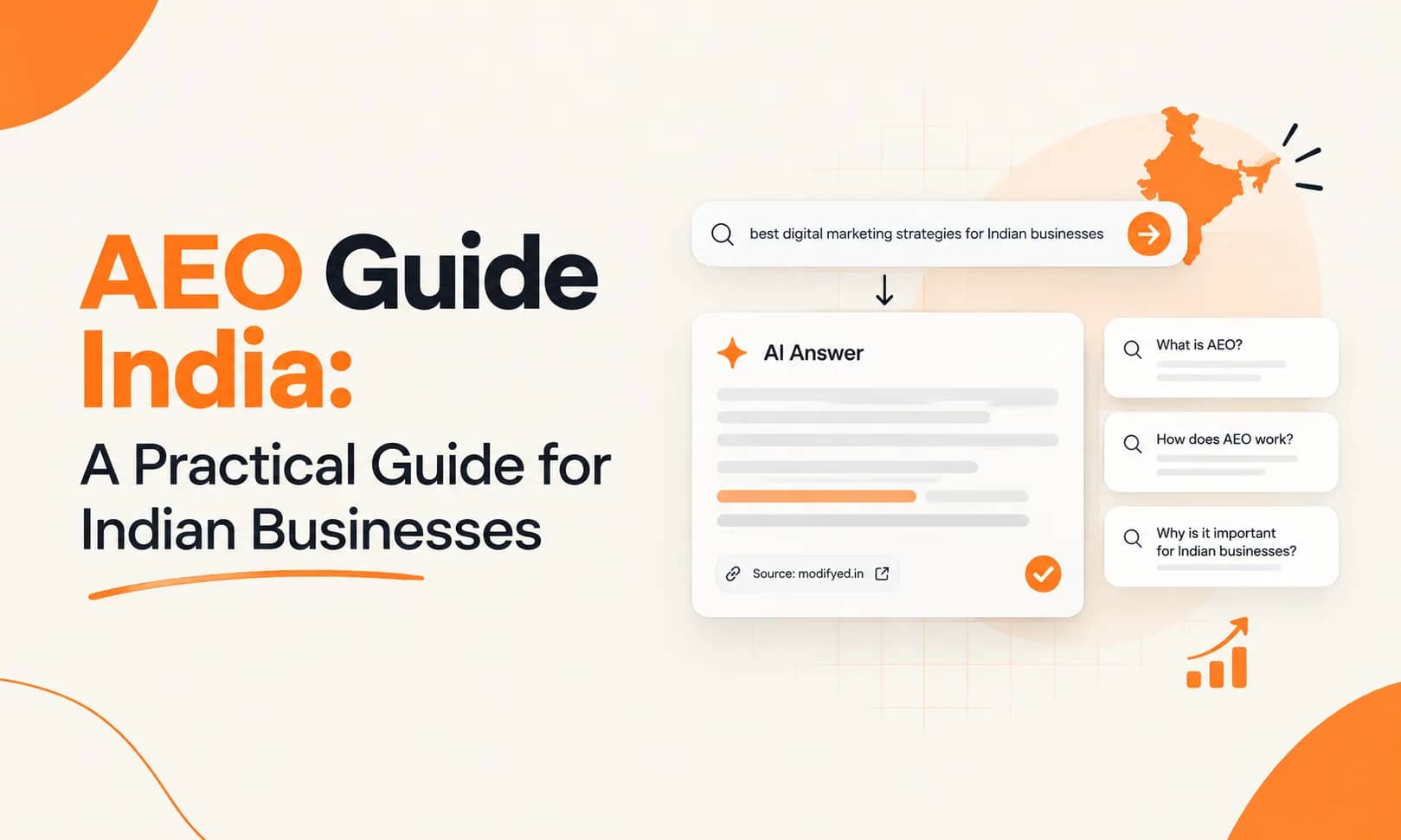
Type a question into Google today and there’s a good chance you get an answer before you get a single blue link – an AI Overview, a featured snippet, or, increasingly, an answer from ChatGPT, Perplexity, or Gemini that never routes through a traditional search results page at all. For Indian businesses that built their entire digital visibility strategy around ranking in ten blue links, this shift changes what “showing up in search” actually means – which is exactly why this AEO guide India exists.
AEO (Answer Engine Optimization) is the practice of structuring content so it gets selected as the direct answer inside AI Overviews, featured snippets, voice assistants, and chat-based AI tools rather than just ranking as a clickable link. It matters because a growing share of searches now resolve without a click at all, and if your content isn’t structured to be the extracted answer, you’re invisible at that moment even if you’d have ranked #1 the old way.
AEO, SEO, and GEO the difference that actually matters practically
These three terms get used almost interchangeably online, which causes real confusion. Here’s the distinction that matters for a business making decisions, not just for terminology precision:
- SEO gets your page to rank in the list of search results, competing for clicks.
- AEO gets your content selected as the direct answer shown above or instead of that list the goal shifts from “get clicked” to “get extracted and shown.”
- GEO (Generative Engine Optimization) is the broader practice of shaping how AI systems like ChatGPT, Perplexity, and Gemini understand and represent your brand across their generated responses, not just for one query but as a consistent entity.
In practice, for most Indian businesses, SEO and AEO aren’t separate projects; they’re the same content built with an additional discipline layered on: answer the question directly and extractably, in addition to ranking for it.
Why this matters more in 2026 than it did two years ago
AI-driven visitors, when they click through from an AI-generated answer, have been observed converting at meaningfully higher rates than typical organic search traffic the visitor arrives already primed by the answer they just read, closer to a decision than someone browsing a list of results. But the bigger shift is upstream: a large and growing share of queries never produce a click at all, because the AI answer satisfies the searcher directly. A business optimised only for the old click-through model is increasingly optimising for a shrinking part of the funnel.
What actually makes content “AEO-ready”
Direct answers within the first 40–60 words of a heading. AI systems and featured snippets extract concise, self-contained answers if your answer to “what is [X]” is buried three paragraphs into a rambling introduction, it’s much harder to extract cleanly, regardless of how good the eventual explanation is.
Question-phrased headings that match how people actually ask. “What is X,” “How does X work,” “Is X worth it for [specific situation]” headings phrased as real questions align directly with both traditional featured snippets and how AI systems decompose a query into sub-questions.
Structured data and clear formatting. Tables for comparisons, numbered steps for processes, FAQ sections with genuinely distinct questions; these formats are easier for AI systems to parse and extract cleanly than dense, unstructured prose.
Self-contained sections. A paragraph that says “the company’s Delhi facility handles X” is extractable and useful on its own. A paragraph that says “the company handles X here” (relying on context from three paragraphs earlier) loses meaning when an AI system extracts it in isolation which is exactly what happens when a passage gets pulled into a generated answer.
Named entities, not vague references. AI systems build understanding through entities and their relationships. A specific product name, a specific city, a specific credential is more useful to an answer engine than “our solution” or “the area.”
An attributed, credible quotation. Content with a real, named expert’s quote or perspective has been shown to meaningfully improve how often AI systems cite a source, likely because it signals a genuine expert view rather than aggregated, generic content.
Table: SEO habits vs AEO additions
| Practice | Traditional SEO goal | AEO addition |
| Headings | Match keyword phrasing | Phrase as the actual question a user would ask |
| Opening paragraph | Establish context, build to the point | Answer the question directly within the first 40–60 words |
| Content depth | Comprehensive coverage of the topic | Comprehensive coverage plus each section standing alone if extracted individually |
| Structured data | Improve crawlability, enable rich results | Improve machine parsing for extraction into AI-generated answers |
| Authority signals | Backlinks, domain trust | Named expert quotes, clear credentials, entity consistency across the web |
A practical AEO checklist for an Indian business website
- Pick your 10–15 highest-value pages (service pages, key blog content) and check: does the first paragraph under each major heading answer the question in under 60 words?
- Convert vague pronoun references (“we,” “this,” “here”) into named entities where a section might realistically be extracted and read in isolation.
- Add or improve FAQ sections with genuinely distinct questions not variations of the same question reworded.
- Wherever a comparison, cost breakdown, or process is being explained in prose, convert it into a table or numbered list.
- Add schema markup (Article, FAQPage as semantic structure, LocalBusiness where relevant) so machine readers have unambiguous structural signals, in addition to what a human reader sees.
- Get at least one genuinely attributed expert quote into your most important pages sourced from a real person at your company or a credible external source, never fabricated.
What AEO does not mean
It doesn’t mean abandoning long-form, thorough content AI systems still favour comprehensive, well-sourced pages when synthesising an answer; a thin page optimised only for extraction without real depth tends to underperform both traditional SEO and AEO simultaneously. It also doesn’t mean keyword-stuffing question phrases into every heading regardless of natural fit over-optimisation measurably reduces AI visibility rather than improving it, the same way it damages traditional SEO.
When Indian businesses tend to get AEO wrong
Treating it as a separate project from existing content. AEO works best layered onto genuinely good, comprehensive content restructuring thin or low-quality pages for extractability doesn’t fix the underlying quality problem, it just makes a thin answer easier to find.
Ignoring GEO-level entity consistency. If a business’s name, address, service descriptions, and credentials are inconsistent across its website, directories, and social profiles, AI systems have a harder time building confident understanding of the brand; this is a governance issue, not just a content one.
Chasing AEO while robots.txt or meta directives block AI crawlers. A page can be perfectly structured for extraction and still be invisible to AI systems if OAI-SearchBot or similar crawlers are blocked, or if a noai/nosnippet directive is inadvertently applied a technical check worth confirming before investing further in content restructuring.
FAQs
No AEO builds on SEO rather than replacing it. Ranking well remains foundational; AEO adds the discipline of making content directly extractable as an answer, on top of ranking for it.
It applies at any scale: a well-structured, specific answer from a small local business can be extracted and cited just as readily as one from a large brand, sometimes more so, since AI systems reward specificity over size.
AEO focuses on individual pieces of content being selected as direct answers; GEO is the broader practice of shaping how AI systems understand and represent a brand consistently across all their generated responses, not just one page.
Not necessarily a full rewrite often it’s a restructuring pass (direct answers up top, question-phrased headings, tables where useful) rather than a wholesale content rebuild, provided the underlying content is already accurate and comprehensive.
It’s measured differently from traditional rankings tracking brand mentions and citations within AI-generated answers, and the specific queries that precede those mentions, rather than a position on a results page.