What Is Digital Marketing? Types, Strategy, Channels & Examples
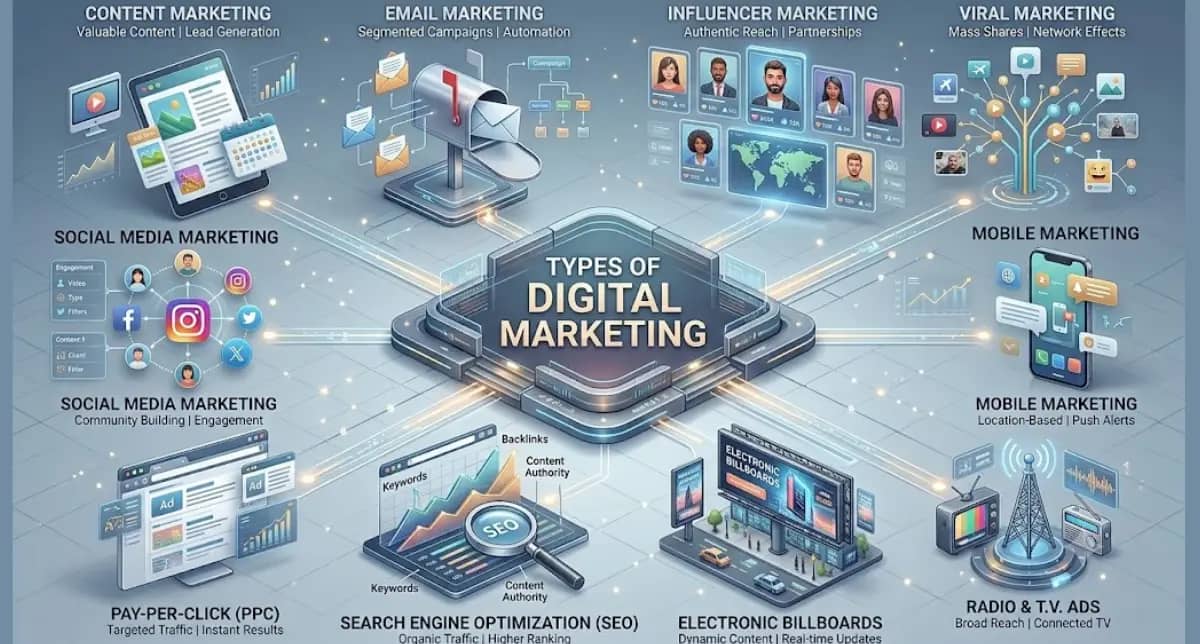
Digital marketing is the use of digital channels, platforms, content and technology to reach, engage, convert and retain customers. It includes SEO, PPC, social media, content marketing, email marketing, performance marketing, websites, messaging platforms and other digital touchpoints.
But effective digital marketing is not simply about being present on every online channel. It is about choosing the right channels for your audience, connecting them to a clear customer journey, measuring what happens at each stage, and continuously improving the strategy based on business results.
Key Takeaways
- Digital marketing uses digital channels to promote brands, products and services.
- Major digital marketing channels include SEO, PPC, social media, content marketing, email marketing and performance marketing.
- A strong strategy connects channels instead of treating every channel as a separate activity.
- Digital marketing can support awareness, traffic, leads, sales, revenue and customer retention.
- Analytics and conversion tracking are essential for measuring actual performance.
- Modern digital marketing increasingly includes AEO, GEO and optimization for AI-driven search experiences.
What Is Digital Marketing?
Digital marketing is the practice of marketing a business, product, service or brand through digital channels and connected technologies.
These channels can include search engines, websites, social media platforms, email, paid advertising, mobile applications, messaging platforms and online communities.
For example, someone might discover a business through Google, read one of its blog articles, visit a service page, see a social media post, click a paid advertisement and eventually submit a lead form. Several digital marketing channels may influence that single customer journey.
The important point is that digital marketing is not one tactic or one platform. It is a connected system of channels working toward business goals.
For businesses looking for a coordinated approach, digital marketing services can bring search, advertising, content, social media, email and conversion activity together under one strategy.
How Does Digital Marketing Work?
A useful way to understand digital marketing is to look at the customer journey:
Discover → Explore → Evaluate → Convert → Retain
1. Discover
A potential customer first becomes aware of a business through channels such as:
- Google search
- Social media
- YouTube
- Display advertising
- Online publications
- Influencer content
- Referrals
- Paid campaigns
The objective at this stage is to create relevant visibility among the right audience.
2. Explore
Once people know about a brand, they may visit its website, social profiles, blog or product pages.
This is where content, website experience, brand positioning and credibility become important.
3. Evaluate
Customers often compare several options before making a decision.
They may:
- Read reviews
- Compare prices
- Search for alternatives
- Read case studies
- Watch videos
- Check social proof
- Search for specific questions
- Visit a website multiple times
Digital marketing allows businesses to support this research process with useful information and relevant messaging.
4. Convert
The customer takes the desired action.
Depending on the business, that could mean:
- Buying a product
- Requesting a quote
- Booking a consultation
- Filling out a lead form
- Calling the business
- Registering for an event
- Starting a free trial
5. Retain
Digital marketing doesn’t stop after conversion.
Email marketing, remarketing, social media, content, loyalty campaigns and customer communication can help businesses retain customers and encourage repeat purchases or referrals.
What Are the Main Types of Digital Marketing?
Digital marketing includes multiple disciplines, including SEO services, PPC, social media marketing, content marketing, email marketing and performance marketing.
The right combination depends on the business, target audience, industry, competition, budget and growth objectives.
1. Search Engine Optimization (SEO)
SEO is the process of improving a website and its content so that relevant pages can appear more prominently in organic search results.
A strong SEO strategy can include:
- Keyword research
- Search intent analysis
- On-page optimization
- Technical SEO
- Internal linking
- Content optimization
- Digital PR and link acquisition
- Local SEO
- Structured data
- Image optimization
For businesses that need to improve organic visibility, SEO services can combine technical improvements, on-page optimization, content strategy and authority building.
If you’re new to SEO, our upcoming guide on what SEO is will explain how search engine optimization works, what it includes and why it matters.
What Is SEO?
SEO focuses on earning relevant organic visibility rather than paying for every click.
For example, a healthcare business may create useful content around treatment-related questions while optimizing relevant service pages for high-intent searches.
SEO is generally a long-term channel. Results depend on competition, website quality, content, authority, technical health and consistent implementation.
2. Pay-Per-Click (PPC) Advertising
PPC advertising allows businesses to pay for visibility on platforms such as search engines and social networks.
Common PPC activities include:
- Google Ads
- Microsoft Advertising
- Paid social advertising
- Display campaigns
- Shopping campaigns
- Remarketing
- Lead-generation campaigns
If a business wants to acquire targeted traffic through paid campaigns, PPC services can support campaign strategy, targeting, advertising and performance optimization.
We will also cover what PPC is in a dedicated guide explaining PPC models, bidding, targeting, costs, metrics and campaign structure.
How PPC Differs From SEO
SEO focuses primarily on earning organic visibility, while PPC uses paid advertising to gain visibility.
The two channels can work together.
For example, a business can use PPC to generate immediate visibility while building SEO assets that can create longer-term organic growth.
3. Social Media Marketing
Social media marketing uses platforms such as Instagram, Facebook, LinkedIn, YouTube and other social networks to build awareness, engagement, community and conversions.
It can include:
- Organic social content
- Paid social advertising
- Short-form video
- Community management
- Influencer collaborations
- Social listening
- Lead-generation campaigns
A business does not necessarily need to be active on every platform.
The better approach is to identify where the target audience spends time and what type of content they respond to.
For businesses that need a structured social presence, social media marketing services can connect content, audience building, community engagement and paid social activity.
A dedicated guide on what social media marketing is will explore the major platforms, strategies, benefits and examples in greater depth.
4. Content Marketing
Content marketing involves creating and distributing useful, relevant content to attract and engage a defined audience.
Examples include:
- Blog articles
- Guides
- Case studies
- Videos
- Research reports
- Ebooks
- Webinars
- Infographics
- Product education
- Comparison pages
- FAQs
Effective content marketing services should not be about publishing content simply to fill a calendar.
Each piece should have a purpose, such as answering a customer question, supporting a buying decision, improving search visibility, generating leads or strengthening brand authority.
For SEO, content also creates opportunities to build topical relevance around important subjects.
Our upcoming guide on what content marketing is will go deeper into content types, strategy, distribution and measurement.
5. Email Marketing
Email marketing allows businesses to communicate directly with prospects and customers who have opted in to receive communications.
Common uses include:
- Welcome emails
- Newsletters
- Product updates
- Promotional campaigns
- Lead nurturing
- Abandoned-cart emails
- Customer retention
- Re-engagement campaigns
Email can be particularly valuable after a prospect has already interacted with a brand.
For example:
Website visit → Lead form → Email nurture → Sales conversation → Conversion
A dedicated guide on what email marketing is will cover email types, campaign strategy, automation, segmentation and measurement.
6. Performance Marketing
Performance marketing focuses on measurable actions and outcomes.
Depending on the business, those outcomes might include:
- Leads
- Sales
- App installs
- Registrations
- Qualified enquiries
- Revenue
Performance marketing can combine paid search, paid social, affiliate marketing, landing-page optimization, analytics and conversion optimization.
The defining principle is measurable business performance rather than visibility alone.
Modifyed also approaches performance marketing as part of a connected full-funnel system, where search, ads, content, email and the website work toward the same revenue objective.
Our upcoming guide on what performance marketing is will explain performance models, channels, KPIs and practical examples in more detail.
7. Conversion Rate Optimization (CRO)
Getting traffic is only part of digital marketing.
Conversion Rate Optimization focuses on improving the percentage of visitors who complete a desired action.
CRO can involve testing and improving:
- Landing pages
- Forms
- Calls to action
- Navigation
- Page layouts
- Messaging
- Trust signals
- Checkout experiences
For example, improving the conversion rate of an existing 10,000 monthly visitors can sometimes create more business value than simply trying to generate another 10,000 visitors.
CRO therefore connects marketing activity with the actual user experience after someone arrives on the website.
8. Local Digital Marketing
Businesses serving specific locations can use digital marketing to increase visibility among nearby customers.
Local strategies can include:
- Google Business Profile optimization
- Local SEO
- Location pages
- Local content
- Reviews
- Local citations
- Maps visibility
- Location-based advertising
This can be particularly important for healthcare, education, hospitality, real estate, professional services and other location-dependent businesses.
Local visibility is often driven by a combination of organic search, Google Business Profile activity, reviews and a strong website experience.
9. AEO, GEO and AI Search Optimization
Search is evolving beyond traditional blue-link results.
People increasingly use AI-powered search and answer engines to research questions, compare options and discover brands.
What Is AEO?
Answer Engine Optimization (AEO) focuses on making information clear, structured and useful for answer-oriented search experiences.
You can learn more in Modifyed’s existing guide to Answer Engine Optimization (AEO).
What Is GEO?
Generative Engine Optimization (GEO) focuses on improving how a brand and its information can be understood and surfaced within generative AI and AI-powered search experiences.
Does AEO or GEO Replace SEO?
No.
SEO remains an important foundation.
Technical accessibility, useful content, clear information architecture, authority and strong user experience still matter.
AEO and GEO should be considered additional layers within a broader search visibility strategy rather than replacements for SEO.
We will cover SEO vs AEO vs GEO in a dedicated comparison guide as this search landscape continues to evolve.
Why Is Digital Marketing Important for Businesses?
Digital marketing matters because customers use digital channels throughout the buying journey.
A potential customer might discover a brand through search, compare it through reviews, watch its social content, visit the website, return through remarketing and finally convert after receiving an email.
Digital marketing gives businesses the ability to participate in these moments.
1. Reach a Specific Audience
Digital platforms provide multiple ways to reach audiences based on factors such as:
- Search behaviour
- Interests
- Location
- Demographics
- Previous interactions
- Website behaviour
- Purchase activity
2. Measure Performance
Digital channels can provide detailed performance data.
Businesses can track metrics such as:
- Impressions
- Clicks
- Website sessions
- Engagement
- Leads
- Conversions
- Cost per lead
- Customer acquisition cost
- Revenue
- ROAS
3. Improve Targeting
Instead of communicating the same message to everyone, businesses can create different campaigns and content for different audience segments.
4. Build Long-Term Visibility
SEO, content, social communities, email databases and brand authority can continue generating value beyond a single campaign.
5. Connect Marketing Activity to Business Outcomes
The strongest strategies don’t stop at traffic.
They connect:
Visibility → Engagement → Leads → Sales → Revenue → Retention
That is why tracking business outcomes is more useful than reporting traffic alone.
Digital Marketing vs Traditional Marketing
Traditional marketing generally uses offline channels such as:
- Television
- Radio
- Newspapers
- Magazines
- Billboards
- Direct mail
- Outdoor advertising
Digital marketing uses channels such as:
- Search engines
- Websites
- Social media
- Online advertising
- Video platforms
- Messaging platforms
The difference isn’t simply that one is online and the other is offline.
The bigger difference is how audiences can be reached, measured, segmented and engaged.
For a deeper comparison, see our upcoming guide to digital marketing vs traditional marketing, which will compare channels, costs, targeting, measurement and use cases.
How to Create a Digital Marketing Strategy
A successful digital marketing strategy should start with the business rather than the platform.
Step 1: Define the Business Objective
Start with a measurable objective.
For example:
- Increase qualified leads
- Increase online sales
- Improve customer retention
- Enter a new market
- Increase brand awareness
- Reduce customer acquisition cost
Step 2: Understand the Audience
Identify:
- Who your customers are
- What problems they have
- What they search for
- What influences their decisions
- Which platforms they use
- What prevents them from converting
Step 3: Analyse Competitors
Study competitors to understand:
- Their positioning
- Search visibility
- Content strategy
- Paid advertising
- Social presence
- Offers
- Landing pages
- Reviews
- Customer experience
The objective isn’t to copy competitors.
It is to identify opportunities to differentiate.
Step 4: Select the Right Channels
Don’t choose channels simply because they are popular.
Choose them because they help you reach your audience and achieve your business objective.
For example:
High-intent search → SEO + PPC
Brand discovery → Social + Video
Lead nurturing → Email + Remarketing
Local customers → Local SEO + Google Business Profile
AI/search visibility → SEO + AEO/GEO
Step 5: Build the Conversion Journey
Make sure your traffic has somewhere useful to go.
That could be:
Search → Service page → Lead form → Sales team
or:
Social → Educational content → Landing page → Lead
or:
Paid ad → Product page → Checkout → Purchase
Step 6: Track the Right KPIs
Your reporting should connect marketing activity to business results.
Instead of reporting only:
“Organic traffic increased.”
Ask:
“Did organic traffic generate more qualified enquiries, revenue or other valuable actions?”
Step 7: Test, Learn and Improve
Digital marketing is not a one-time activity.
Campaigns, landing pages, audiences, content and messaging should be reviewed regularly and improved based on actual performance.
Digital Marketing Examples
Example 1: Education Business
An education brand wants more student enquiries.
A possible strategy could combine:
SEO → Course pages → Educational content → Google Ads → Lead forms → Remarketing → Email/WhatsApp follow-up
The objective is not simply to increase website traffic.
It is to generate more qualified student enquiries.
Example 2: E-commerce Brand
An e-commerce brand may use:
SEO → Product/category pages → Shopping Ads → Social Ads → Remarketing → Email → Repeat purchase
Here, customer acquisition and retention work together.
Example 3: Local Healthcare Business
A local healthcare business could use:
Local SEO → Google Business Profile → Service pages → Educational content → Reviews → Conversion-focused enquiry journey
This helps the business appear when potential patients are actively looking for relevant services.
How Much Does Digital Marketing Cost?
There is no single digital marketing price that applies to every business.
Cost depends on factors such as:
- Business size
- Industry
- Competition
- Target geography
- Number of channels
- Advertising budget
- Content requirements
- Website condition
- Business objectives
- Required level of strategy and execution
A small local business may need a focused local SEO and paid-search strategy, while a national brand may require SEO, content, paid media, social media, analytics and conversion optimization across multiple markets.
The right question is therefore not simply:
“How much does digital marketing cost?”
It is:
“Which digital activities can generate the highest business value within our available budget?”
What Metrics Should You Track in Digital Marketing?
The right metrics depend on the objective.
| Goal | Useful Metrics |
| Brand awareness | Reach, impressions, branded search |
| SEO | Organic clicks, impressions, rankings, conversions |
| Paid advertising | CTR, CPC, conversions, CPA, ROAS |
| Social media | Reach, engagement, clicks, leads |
| Content | Organic traffic, engagement, assisted conversions |
| Lead generation | Leads, qualified leads, CPL, conversion rate |
| E-commerce | Revenue, ROAS, AOV, conversion rate |
| Retention | Repeat purchases, retention rate, email engagement |
| Overall marketing | CAC, revenue, pipeline, ROI |
A strong reporting framework should connect channel-level metrics to actual business outcomes.
For example, a campaign with a high click-through rate isn’t necessarily successful if those clicks don’t generate qualified leads or revenue.
Common Digital Marketing Mistakes
Even businesses investing heavily in digital marketing can struggle when their activities are disconnected.
Using Every Channel Without a Strategy
Being active everywhere does not automatically create results.
Focusing Only on Traffic
Traffic is useful, but qualified traffic and conversions are more important.
Creating Content Without Understanding Search Intent
Publishing more content does not guarantee more visibility.
Running Ads Without Conversion Tracking
Without reliable tracking, it becomes difficult to know which campaigns are actually generating value.
Ignoring the Website Experience
A successful campaign can still underperform if the landing page is slow, confusing or difficult to navigate.
Treating SEO as a One-Time Project
SEO requires ongoing technical, content, authority and performance improvements.
Measuring Channels Separately
Customers often interact with multiple channels before converting. Looking at each channel in isolation can hide the real customer journey.
What Is the Future of Digital Marketing?
Digital marketing is becoming increasingly connected to data, automation, AI and changing search behaviour.
Areas marketers need to pay attention to include:
- AI-assisted search
- AEO
- GEO
- First-party data
- Personalization
- Marketing automation
- Video content
- Social search
- Conversational marketing
- Privacy-conscious measurement
- Conversion optimization
- Full-funnel attribution
But new technology does not eliminate the fundamentals.
Businesses still need:
A clear value proposition + useful content + strong customer experience + measurable distribution + continuous optimization.
Technology changes the tools.
The underlying marketing objective remains the same: reach the right people, give them a reason to trust you, and make it easy for them to take the next step.
Frequently Asked Questions
Digital marketing means promoting a business, product or service through digital channels such as search engines, websites, social media, email and online advertising.
Common types include SEO, PPC, social media marketing, content marketing, email marketing, performance marketing, affiliate marketing, conversion optimization and other digital advertising activities.
Digital marketing helps businesses reach relevant audiences online, measure campaign performance, generate leads or sales, build brand visibility and improve customer relationships.
Yes. SEO is one of the major disciplines within digital marketing and focuses on improving a website’s organic visibility in search engines.
SEO focuses primarily on earning organic visibility, while PPC uses paid advertising to obtain visibility on advertising platforms. Businesses often use both because they can serve different stages of the customer journey.