250+
CLIENTS SERVED
Experience supporting brands and organizations across education, D2C, enterprise and nonprofit sectors.
SOCIAL MEDIA MARKETING FOR EDUCATIONAL INSTITUTIONS
TWO AUDIENCES, ONE FEED - AND THEY WANT COMPLETELY DIFFERENT THINGS FROM YOU.
A parent scrolling your Instagram wants proof - results, safety, fees and faculty credentials. A student scrolling the same page wants to know if they'd actually fit in there. Most institutional social media picks one audience and loses the other. We build content strategies that speak to both on the same channels, without either audience feeling like an afterthought.

02 / Difference
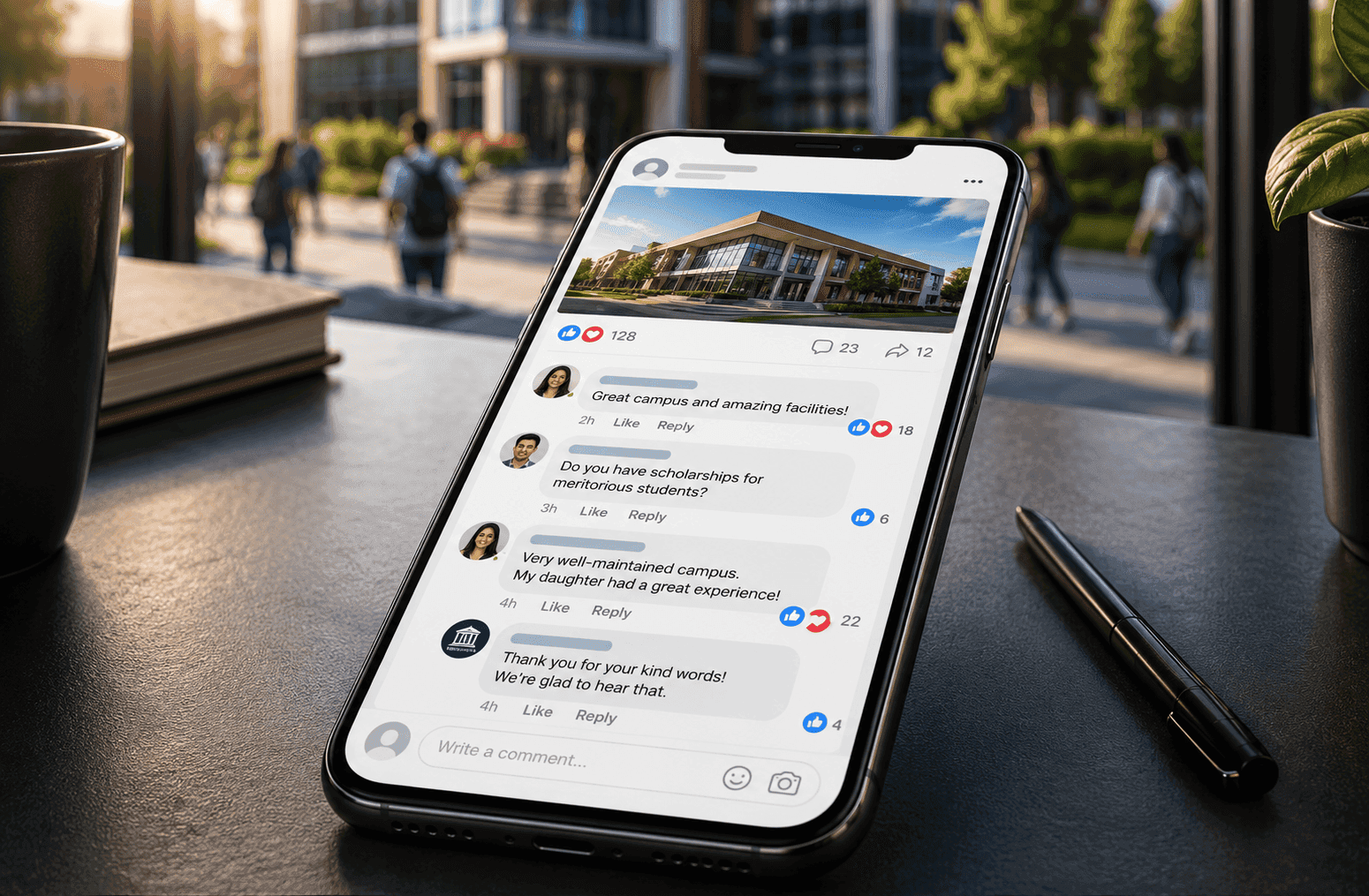
Post only polished institutional content and prospective students can scroll past, unconvinced it reflects real life on campus. Post only student-life content and parents can lose confidence in the institution behind it. Education social media has to do both jobs at once - credibly and consistently.

250+
Experience supporting brands and organizations across education, D2C, enterprise and nonprofit sectors.
280%
Education campaign result demonstrating the impact of performance-focused digital acquisition.
56%
Education campaign result achieved by connecting digital acquisition with the enrolment journey.
1098+
Monthly lead generation achieved through a performance-focused education campaign.
04 / Proof
250+ clients served across industries, with experience building content, community and digital engagement strategies that connect brands with the right audiences and turn social interactions into meaningful brand experiences.















WHY MODIFYED
Most institutional social accounts are run around whatever is easiest to post that week. We build a deliberate content strategy for two audiences with genuinely different needs - while keeping the institution's overall voice consistent.

06 / Our Approach

06 / Our Approach
07 / Brand Types






08 / Services
Parent-facing and student-facing content planned deliberately rather than treating one audience as an afterthought.
Content designed for both discovery through Reels and credibility through feed content, highlights and community interaction.
Long-form and short-form video built around a platform students already use to research, learn and evaluate educational options.
Structured programs designed to bring genuine voices from inside the institution into the content strategy.
Content cadence and themes planned around the institution's actual enquiry and application calendar.
Monitoring and responding to comments and reviews as part of the admissions journey rather than treating community management as a separate task.
Extend the reach of strong organic content during important admission windows through targeted paid amplification.
Build structured content series around real graduate journeys, achievements, placements and outcomes.
Track whether social engagement is contributing to relevant admission enquiries instead of reporting only vanity metrics.
250+
Brands and organizations supported across education, D2C, enterprise, nonprofit and other sectors.
18+
Campaign creatives developed for client social media and paid-media initiatives.
7X
Performance achieved for Sancha Tea through paid social and digital advertising.
10 / Integrated Strategy

Builds awareness, familiarity and trust before a prospective student actively searches.
Capture intent once a family starts actively researching institutions, courses and programs.
Turn that interest into a completed enquiry, application or campus-visit request.
Nurture the relationship across a longer education decision cycle.
Keep public trust intact while prospective families continue researching and comparing institutions.
11 / Questions
Education social media marketing can include content strategy, Instagram and Facebook management, YouTube strategy, faculty and student creator programs, admission-season campaigns, community management, paid social amplification, alumni storytelling and reporting tied to admission enquiries.
We plan different content needs within the same strategy. A campus-life post can highlight the student experience while also communicating information around safety, facilities or outcomes that matters to parents. Similarly, an academic or results-focused post can be presented in a way that remains relevant to students.
Generally, yes. Genuine voices from inside the institution can make content more relatable and credible, particularly for prospective students evaluating whether they would fit into the institution.
Posting cadence should be connected to the institution's admission calendar. Content can become more frequent and conversion-focused around enquiry and application windows, while off-season periods can focus more on awareness, community and long-term brand building.
Yes. For education brands, comments and reviews can become part of a prospective family's due-diligence process. Community management is therefore treated as part of the wider admissions journey.
Yes. Social can contribute to admission enquiries when content is built around clear goals, relevant calls to action, paid amplification where appropriate and reporting that connects social activity to enquiry generation rather than stopping at engagement.
Yes. Coaching institute content can lean more heavily on faculty authority, educational resources, topper stories and results, while school social media generally needs to balance parent concerns such as safety and outcomes with authentic student-life content.
Yes. YouTube can support educational discovery and research through long-form and short-form content. The strategy can include educational resources, faculty-led videos, student experiences, course information and other content aligned with the institution's audience.
Yes. Paid amplification can be used to extend the reach of strong organic content, particularly around important admission and enquiry windows, rather than treating paid and organic activity as completely separate strategies.
Success should be evaluated through engagement quality, relevant audience growth and, most importantly, whether social activity contributes to meaningful admission enquiries. Follower count and likes alone do not show whether the strategy is supporting the admissions journey.
Cost depends on platform scope, content production requirements, video needs, community management, paid amplification and the institution's goals. We recommend defining the scope around the admission objectives rather than applying one fixed package to every institution.
Education social media has to serve different audiences on the same channels, work around an admission calendar and withstand the public scrutiny that comes with a high-trust decision. A specialized strategy can account for these requirements rather than applying a generic social media calendar.
READY TO GROW?
Whether you're building your institution's social presence from scratch or replacing an agency posting generic content that neither audience meaningfully engages with, we'll audit your current channels, identify where you're losing one audience for the other and build a strategy designed to speak to both.