WordPress vs Shopify: Which Is Right for Your Business?
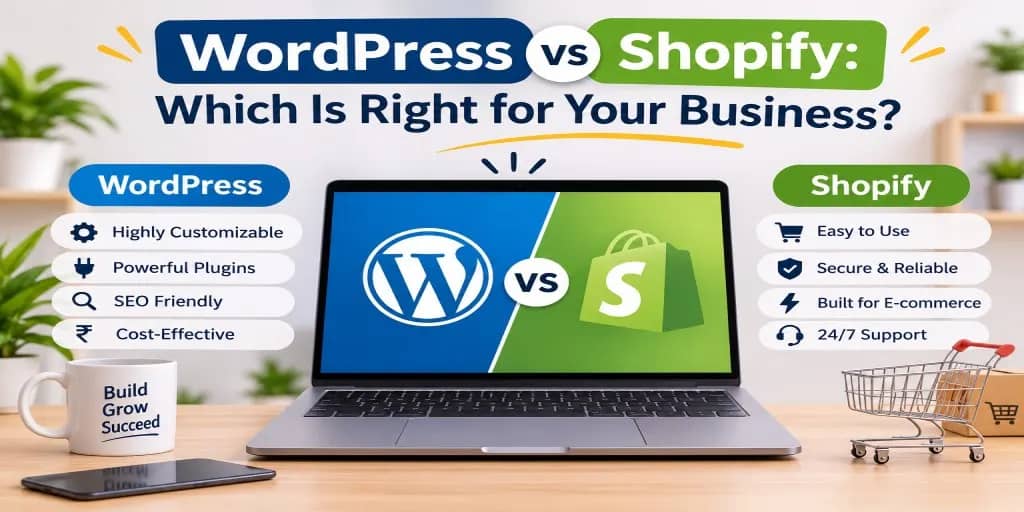
Choose Shopify if selling products online is the main job of your website and you do not have a developer on call. Choose WordPress if content, lead generation or heavy customisation matters more than the checkout. That is the short answer to WordPress vs Shopify. The longer answer depends on what you sell, who will maintain the site, and how the fees work in India, which most comparisons written for US readers get wrong.
What is the actual difference between WordPress and Shopify?
Shopify is a hosted ecommerce platform: you pay a monthly fee and it provides hosting, security, checkout and updates. WordPress is free, open-source software you install on your own hosting, and it needs the WooCommerce plugin to sell products. Shopify rents you a finished shop. WordPress gives you land and a toolkit.
Both are mainstream choices. According to W3Techs data for 15 November 2026, WordPress runs 38.6% of all websites and Shopify runs 5.4%, which makes them the two most widely used content management systems on the web. Neither is a risky pick. They are built for different jobs.
WordPress vs Shopify at a glance
| Factor | Shopify | WordPress (with WooCommerce) |
|---|---|---|
| Type | Hosted, subscription | Self-hosted, open source |
| Setup effort | Low. A store can go live in days | Medium to high. Hosting, theme, plugins, security |
| Monthly platform cost | Fixed plan fee | No licence fee. You pay hosting, plugins, upkeep |
| Transaction fee | Charged on third-party gateways | None from the platform |
| Maintenance | Handled by Shopify | Your responsibility |
| Design freedom | High within theme structure | Almost unlimited |
| Content and blogging | Adequate | Excellent |
| Checkout | Standardised and reliable | Fully customisable, quality depends on build |
| Best for | Product-first brands, small teams | Content-led sites, service businesses, complex custom builds |
Which is cheaper in India: Shopify or WordPress?
WordPress usually looks cheaper in month one and Shopify is often cheaper once you count maintenance. The honest comparison is total cost over two or three years. For Indian businesses there is one line item that changes the maths: Shopify’s third-party transaction fee.
What Shopify costs in India
Shopify’s India pricing page lists these plans as of November 2026:
| Plan | Billed monthly | Billed yearly (per month) | Third-party gateway fee |
|---|---|---|---|
| Basic | ₹1,994 | ₹1,499 | 2% |
| Grow | ₹7,447 | ₹5,599 | 1% |
| Advanced | ₹30,164 | ₹22,680 | 0.6% |
| Plus | From ₹1,75,000 | Not listed | 0.2% |
New stores also get an introductory offer. In Shopify’s words: “Try 3 days free, then ₹20/month for 3 months.”
The last column is the one to study. Shopify waives its transaction fee when you use Shopify Payments, but Shopify Payments is not offered to merchants based in India. Indian stores connect a gateway such as Razorpay, Cashfree or PayU, which means the third-party fee applies to online payments in addition to what the gateway itself charges. Manual methods such as cash on delivery are generally not subject to it, but confirm this in your own Shopify admin.
The upgrade break-even most guides skip
Because the fee falls as the plan rises, there is a sales level at which a costlier plan becomes the cheaper option. Using the yearly-billed prices above:
- Basic to Grow: Grow costs ₹4,100 more per month and cuts the fee by one percentage point. It pays for itself once you process about ₹4.1 lakh a month through online gateways.
- Grow to Advanced: Advanced costs ₹17,081 more and cuts the fee by 0.4 points. It pays for itself at roughly ₹42.7 lakh a month.
A store taking ₹5 lakh a month in prepaid orders on Basic pays about ₹10,000 in Shopify transaction fees, before the gateway’s own charge. On Grow, the same store pays ₹5,000. Most owners stay on Basic long after it has stopped being the cheap plan.
What WordPress costs
WordPress and WooCommerce carry no licence fee and no platform transaction fee. You pay only your gateway. The costs sit elsewhere:
- Hosting. Cheap shared hosting works for a brochure site. A store with real traffic needs managed or cloud hosting.
- Theme and plugins. Many are free. Subscriptions, shipping, invoicing and advanced filtering usually need paid plugins with annual renewals.
- Maintenance. Core, theme and plugin updates, backups, security monitoring and fixing whatever an update breaks.
- Developer time. The cost people forget, and usually the largest.
A three-year cost worksheet
Fill this in with real quotes before deciding. It is the only fair way to compare.
| Cost line | Shopify | WordPress + WooCommerce |
|---|---|---|
| Platform or hosting fee × 36 months | Plan fee | Hosting fee |
| Theme (one-time) | Free or paid theme | Free or paid theme |
| Apps or plugins × 36 months | App subscriptions | Plugin renewals |
| Platform transaction fee on projected prepaid sales | 2%, 1% or 0.6% | Nil |
| Gateway fee | Same either way | Same either way |
| Maintenance and security | Included | Monthly retainer or in-house hours |
| Build and customisation | Lower for standard stores | Varies widely |
If your projected sales are modest and you have no technical help, Shopify tends to win this worksheet. If your sales are high, mostly prepaid, and you already employ or retain a developer, WooCommerce’s zero platform fee starts to matter.
Which is better for SEO?
WordPress gives you more control, and Shopify gives you fewer ways to make mistakes. Both can rank well. Shopify handles the technical basics automatically: SSL, sitemaps, canonical tags and fast hosting. Its limits are a fixed URL structure (/products/, /collections/) and a simpler blog.
WordPress lets you control every URL, template and piece of structured data, and its editor is far better for long-form content. That freedom cuts both ways. A WordPress site with twenty poorly coded plugins will be slower than almost any Shopify store.
Our view: if organic content is your main growth channel, as it is for publishers, consultants, education providers and B2B firms, WordPress is the stronger base. If you are a product brand whose SEO is mostly collection and product pages, Shopify’s defaults are enough, and your time is better spent on content and links than on server configuration. Either way, the platform matters less than the work, which is why our SEO services start with an audit, not a migration.
Who should choose Shopify?
- D2C brands and retailers whose website exists mainly to sell products.
- Founders without a developer who want hosting, security and checkout handled.
- Stores planning to sell on Instagram, Google and marketplaces from one catalogue.
- Businesses that value predictable costs over maximum flexibility.
If that sounds like you, our walkthrough of Shopify development services explains what a professional build involves.
Who should choose WordPress?
- Service businesses, institutions and B2B companies where the site generates leads, not orders.
- Content-heavy brands that publish often and need editorial control.
- Stores with unusual requirements: complex product configurators, custom pricing rules, deep ERP integration.
- Teams with a developer or agency on retainer who can own updates and security.
Can you use both together?
Yes, and it is more common than most comparison articles admit. Many brands run their main site and blog on WordPress and add Shopify’s Buy Button or a Shopify store on a subdomain (shop.yourbrand.com) for checkout. You get WordPress’s content strength and Shopify’s checkout reliability.
The trade-off is two systems to manage and a slightly disjointed analytics setup. It suits content-led businesses that sell a small range of products. It does not suit a store with hundreds of SKUs, where a single platform is cleaner.
What about switching later?
Moving between the two is possible and never free. Products, customers and orders can be exported and imported. Designs cannot; the theme is rebuilt. URLs change, so redirects have to be mapped page by page or you will lose rankings.
Two practical points. First, WordPress gives you full ownership of code and database, so leaving is simpler. Second, on Shopify your data exports cleanly but your theme customisations and app logic stay behind. Decide with the next three years in mind, not the next three months. If you are planning a move, a structured website design and development process with a redirect map is what protects your traffic.
Match the platform to the job
WordPress vs Shopify is a question about your business model. Sell products and want simplicity: Shopify, and watch the plan break-even as you grow. Publish, generate leads or need custom logic: WordPress, with a maintenance plan from day one. If you are still undecided, list your three most important site functions and see which platform does them without add-ons. The Modifyed Digital team builds on both, and we are happy to review your requirements before you commit.
Frequently asked questions
For most small and mid-sized product businesses, yes. Shopify’s checkout, hosting and security are managed for you. WordPress with WooCommerce is better when you need custom functionality or want to avoid platform transaction fees at high volume.
Not on the sticker price. WordPress software is free and Shopify’s Basic plan is ₹1,499 a month billed yearly in India. Once hosting, paid plugins and maintenance are added to WordPress, the gap narrows or reverses for small stores.
Yes. Shopify Payments is not available in India, so Shopify’s third-party gateway fee of 2% on Basic, 1% on Grow or 0.6% on Advanced applies to online payments, on top of your gateway’s charge.
Shopify. You can add products and launch without touching hosting or code. WordPress has a steeper start and more ongoing upkeep.
You can limit the loss. Export your data, rebuild the design, and redirect every old URL to its new equivalent before launch. Expect some fluctuation for a few weeks even when it is done well.