Outsource Digital Marketing: What, When and How
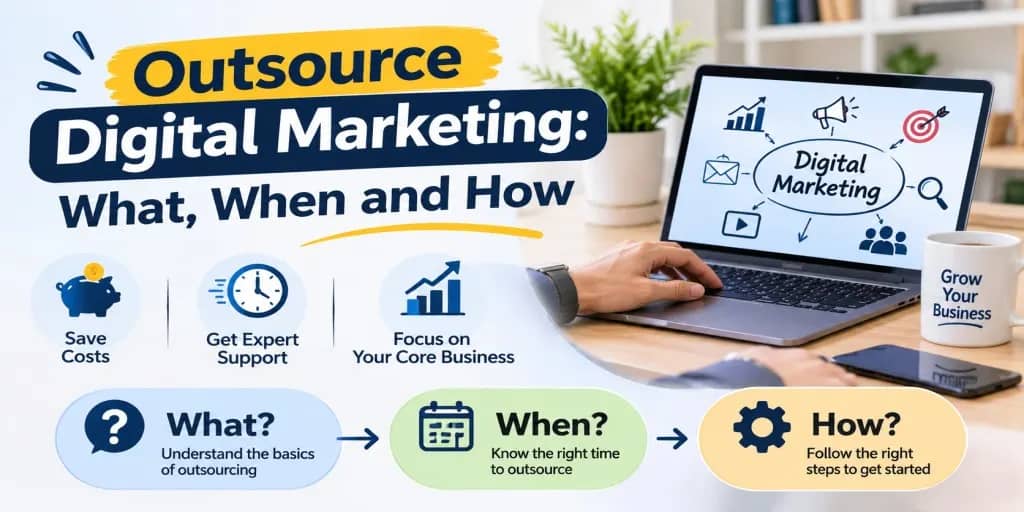
You should outsource digital marketing when the work needs skills you cannot hire affordably, keep strategy and customer knowledge inside the company, and write the contract so you own every account and asset. That is the whole argument in one sentence. The detail below covers what to hand over, the signs that it is time, what it costs in India, and the clauses that protect you if the relationship ends.
What does it mean to outsource digital marketing?
To outsource digital marketing is to pay an external agency, freelancer or consultant to plan or run some of your online marketing: search ads, SEO, social media, content, email, design or analytics. You can outsource a single task, one channel or the whole function. The business keeps ownership of goals and budget, and the partner supplies specialist skill and capacity.
It is common practice, not a shortcut. Clutch’s 2026 pricing guide, drawn from more than 100,000 listed firms, reports that most digital marketing agencies charge $25–$49 an hour and typical projects cost $10,000–$49,999. The spread is wide because the scope is wide. What matters is matching the type of partner to the type of work.
What should you outsource, and what should you keep?
Outsource execution that needs specialist tools and daily practice. Keep decisions that depend on knowing your customers, margins and product. Most businesses get this backwards: they hand over strategy because it feels hard and keep posting on social media because it feels easy.
Use this matrix as a starting point.
| Function | Recommendation | Reason |
|---|---|---|
| Positioning, pricing, offer | Keep | Depends on margins and customer insight only you have |
| Marketing goals and budget | Keep | A partner can advise; the decision is yours |
| Paid search and paid social | Outsource | Platforms change monthly; specialists manage many accounts and spot patterns faster |
| Technical SEO and link building | Outsource | Needs tools, experience and time most teams lack |
| SEO content | Hybrid | Partner writes and optimises; your experts supply the knowledge and review |
| Social media | Hybrid | Partner plans, designs and schedules; you provide real moments, people and approvals |
| Design and video production | Outsource | Project-based and equipment-heavy |
| Email and WhatsApp marketing | Hybrid | Partner builds flows; you own the customer list and tone |
| Analytics and reporting | Hybrid | Partner builds dashboards; you must be able to read them |
| Customer replies and community | Keep | Speed and authenticity matter more than polish |
The principle behind the table: outsource skills, keep judgment. A partner should make you better informed, never more dependent.
When should you outsource digital marketing?
Outsource when at least two of the following are true. One alone is usually a staffing problem, and two or more is a capability gap.
- Results have stalled for a quarter and no one internally knows why.
- You need three or more specialisms (say, paid ads, SEO and design) and can afford one hire.
- Campaigns launch late because the team is stretched.
- You are entering a new channel or market and learning by trial would cost more than expert help.
- Reporting is a spreadsheet of activity, with no link to leads or revenue.
- A key marketer has left and the function stopped with them.
There are also times not to outsource. If you have not defined your customer or your offer, an agency will spend your money finding out. If nobody internally can give feedback and approvals each week, work will queue up. Fix those first.
Agency, freelancer or in-house hire?
Each model suits a different need. The mistake is choosing on price before choosing on fit.
| Model | Best for | Strength | Watch out for |
|---|---|---|---|
| Freelancer | One clearly defined task or channel | Low cost, direct contact | Single point of failure, limited capacity |
| Specialist agency | One channel done to a high standard | Depth, tools, benchmarks | You coordinate between vendors |
| Full-service agency | Several channels under one plan | Integrated strategy, one team, one report | Needs a clear internal owner |
| In-house hire | Constant, brand-specific work | Context, speed, availability | One person rarely covers every skill |
| Fractional lead plus agency | Strategy gap and execution gap | Senior direction without a full salary | Two relationships to manage |
Many growing companies end up with a hybrid: one internal marketing owner who knows the business, and an agency that supplies the specialists. In our experience that structure outperforms both extremes, because someone inside the company is accountable and someone outside brings pattern recognition from other accounts.
How much does it cost to outsource digital marketing in India?
Monthly agency retainers in India commonly run from a few tens of thousands of rupees for a single channel to several lakh for a full multi-channel programme, with ad spend billed separately. Published rate cards vary too much to quote a reliable average, so treat any single figure with caution and ask for an itemised scope.
A more useful comparison is cost per capability. One mid-level in-house marketer covers perhaps one or two specialisms. An agency retainer of similar size typically gives you part of a strategist, a media buyer, an SEO specialist, a designer and a writer, plus the software they use. The retainer buys range; the salary buys focus and availability.
Three things move the price:
- Number of channels. Each adds people and hours.
- Volume of creative. Design and video are the most labour-intensive parts of most scopes.
- Ad spend under management. Larger budgets need more testing and reporting.
Ask every shortlisted partner to price the same written scope. Proposals built on different assumptions cannot be compared.
How to outsource digital marketing: a six-step process
- Write a one-page brief. Business goal, target customer, current numbers, budget range, channels you think you need, and what success looks like in six months.
- Shortlist three to five partners. Look for experience in your industry or business model, and ask who will actually work on your account. Our list of digital marketing agencies in India is one place to begin.
- Ask the questions that reveal quality. How will you measure success? What would you stop doing in our current marketing? Can we speak to a client who left you? What happens in the first 30 days?
- Check for red flags. Guaranteed rankings or guaranteed ROAS. Reluctance to give you admin access. Reports full of impressions and no revenue. Lock-in longer than six months with no exit clause.
- Agree the contract using the checklist below.
- Onboard properly. Share access, brand guidelines, past data and customer insight in week one. Agree a weekly call and a monthly review. Expect the first month to be audit and setup, with performance judged from month three.
The contract checklist most businesses skip
This section is what protects you. Add these points to any agreement before signing.
- Account ownership. Ad accounts, analytics, Search Console, Merchant Center, social pages and the domain are created in your business’s name. The agency gets partner access, never sole ownership.
- Data and audiences. Customer lists, pixel data and remarketing audiences belong to you and stay in your accounts.
- Creative and content. Source files for designs, videos and copy transfer to you on payment.
- Scope and exclusions. A list of what is included each month and what is charged extra.
- Reporting. Named metrics tied to leads or revenue, a fixed date each month, and live dashboard access.
- Ad spend handling. Media is billed directly to your card, or invoiced at cost with platform receipts.
- Notice and exit. Thirty days’ notice after an initial term, and a handover obligation covering access, files and documentation.
- Confidentiality. An NDA, and a data-processing clause if the partner handles customer data.
If a prospective partner resists the first point, end the conversation. An agency that owns your ad account owns your history, and leaving them means starting again from zero.
What results should you expect, and when?
Expect setup and learning in month one, early signals in months two and three, and a fair verdict at six months. Paid channels show direction within weeks. SEO and content take longer to compound.
Judge by outcomes. For example, Tech Mahindra Foundation’s SMART Academy programme, which we have supported for six years, has generated more than 50,000 leads and an 85% increase in training enrolments, as published on our site. Those are the kinds of numbers a monthly report should lead with: leads, enrolments, sales, cost per result. Reach and impressions belong further down the page.
Hand over the work, keep the wheel
Outsource digital marketing for skills and capacity, and keep ownership of strategy, accounts and customer knowledge. Use the matrix to decide what goes, the six steps to choose who gets it, and the checklist to make sure you can leave with everything you paid for. If you would like to see what a scoped proposal looks like, the Modifyed Digital team can prepare one from your brief for our digital marketing services, or you can start with a conversation.
Frequently asked questions
Outsource when you need several specialist skills and cannot justify several salaries. Hire in-house when the work is constant and depends on deep brand knowledge. Most companies between startup and enterprise do best with one internal owner and an external team.
Start with the channel that is closest to revenue and hardest to do well internally. For most businesses that is paid advertising or SEO.
Loss of control over accounts and data, generic work from a partner who does not understand your customer, and dependence on one vendor. A clear contract, weekly communication and ownership of all accounts reduce each of these.
Agree three or four metrics before work starts: cost per lead or sale, lead quality, revenue attributed, and organic traffic to commercial pages. Review them monthly against the baseline from before the engagement.
Yes, by outsourcing one channel with a tight scope. A narrow engagement done well beats a broad one done thinly.