Instagram Marketing Strategy: What Works in India in 2026
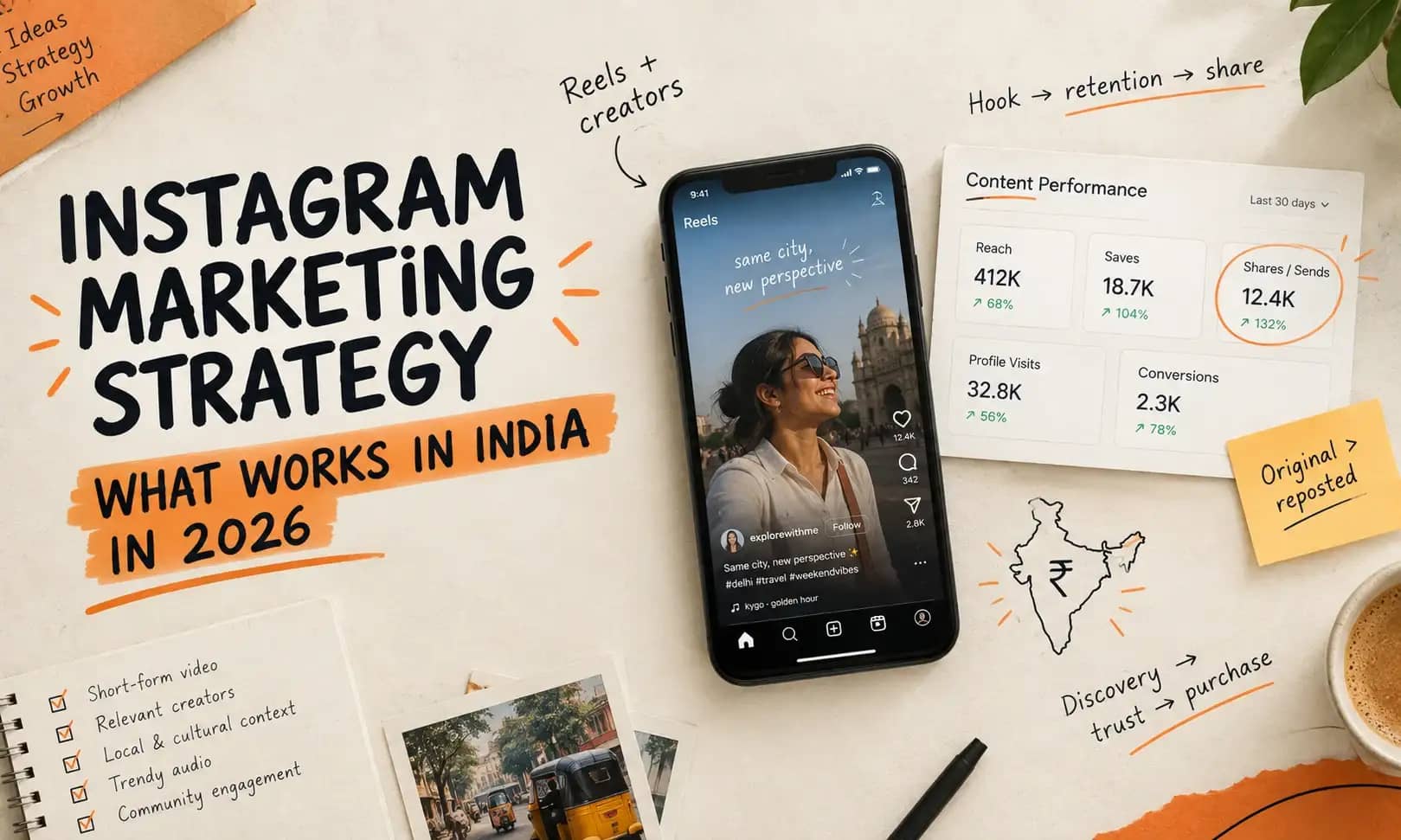
Instagram marketing in 2026 is no longer about posting a few Reels every week and hoping one goes viral.
For Indian businesses, Instagram can support brand discovery, audience engagement, product education, lead generation, customer conversations, and sales. But the strategy that works for a Gurgaon dental clinic will not necessarily work for a D2C fashion brand, a B2B manufacturer, or a local education business.
The difference is having a strategy that connects content, audience, distribution, conversations, and business outcomes.
India has a huge addressable Instagram audience. NapoleonCat’s August 2026 data estimates more than 550 million Instagram users in India, with people aged 25–34 representing the largest age group in its dataset. The figures are estimates based on platform marketing API data and refer to the addressable audience rather than every person who may use Instagram.
So the opportunity is significant. The challenge is turning attention into something a business can actually measure.
This guide explains how to build an Instagram marketing strategy for the Indian market in 2026, which content formats to use, how to improve discovery, how to generate leads, what to measure, and where businesses commonly go wrong.
What Is Instagram Marketing?
Instagram marketing is the use of Instagram’s organic content, community features, advertising tools, and business features to achieve specific marketing objectives.
These objectives may include:
- Increasing brand awareness
- Reaching new audiences
- Building trust
- Generating leads
- Driving website traffic
- Promoting products or services
- Increasing sales
- Building a community
- Supporting customer retention
It is important to distinguish Instagram marketing from simply posting on Instagram.
Posting asks:
“What should we publish this week?”
Marketing asks:
“What business outcome are we trying to achieve, and what content can help us get there?”
For example:
Goal: Generate consultations
↓
Audience: People looking for dental treatment in Gurgaon
↓
Content: Educational Reels + treatment explainers + FAQs + patient stories
↓
CTA: Book a consultation / Send a WhatsApp message
↓
Measurement: Qualified enquiries and bookings
That is a marketing system rather than just a content calendar.
Why Instagram Marketing Matters for Indian Businesses
Instagram gives businesses multiple opportunities to interact with potential customers during different stages of the buying journey.
A person may:
- Discover a brand through a Reel.
- Visit its profile.
- Watch a few Stories.
- Save an educational carousel.
- Read customer reviews.
- Send a DM.
- Visit the website.
- Ask a question on WhatsApp.
- Eventually purchase or book a service.
The path will differ by industry, but the underlying principle remains the same:
Attention → Interest → Trust → Action
Instagram is particularly useful when a business can communicate its value visually or demonstrate expertise through useful content.
Examples
A skincare brand can show:
- Product demonstrations
- Ingredient education
- Routines
- Customer experiences
- Creator content
- Before-and-after content where appropriate
A B2B company can show:
- Industry expertise
- Product demonstrations
- Factory or workplace content
- Client stories
- Founder insights
- Educational content
A local clinic can use:
- Doctor-led educational videos
- FAQs
- Treatment explainers
- Patient education
- Location-based content
- Appointment CTAs
The strategy should therefore be based on the audience and business objective, not on copying what another account is posting.
Instagram Marketing Strategy in India: What Has Changed in 2026?
The Instagram environment continues to evolve, which means businesses need to pay attention to how content is distributed and discovered.
Rather than trying to “hack the algorithm,” businesses should focus on creating content that people actually choose to watch, like, save, share, discuss, or act on.
1. Watch Time and Engagement Signals Matter
Instagram has publicly discussed several signals used in ranking and recommendations, including watch time, likes, and sends. These signals can play different roles depending on whether Instagram is evaluating content for existing followers or broader recommendations.
That means the goal shouldn’t simply be:
“Get likes.”
Instead, ask:
- Does the opening make people keep watching?
- Is the information useful enough to save?
- Would someone send it to a friend?
- Does it answer a genuine question?
- Does it give the audience a reason to interact?
A Reel explaining a common customer problem may therefore have more strategic value than a highly polished promotional video that provides little useful information.
2. Original Content Matters
Businesses should avoid building their Instagram presence around copied or minimally changed content.
Original content can include:
- Your own videos
- Your team
- Your products
- Your customers
- Your workplace
- Your processes
- Your expertise
- Your original opinions and explanations
- Original graphics and educational content
This is particularly important for businesses competing in crowded categories.
For example, dozens of digital marketing agencies can create a Reel saying:
“5 Instagram Marketing Tips”
But a more distinctive approach would be:
“We reviewed 20 Indian business Instagram accounts. Here are the three content mistakes we saw most often.”
The second concept gives the audience a reason to watch because it is based on a specific observation rather than generic advice.
3. Instagram Is Becoming Part of a Wider Search Journey
Instagram content should not be created only for people who already follow your account.
Users can discover businesses through Instagram search, recommendations, shared content, and increasingly through search engines and other digital touchpoints.
This creates an opportunity for businesses to make their content more descriptive and searchable.
Instead of writing:
“Your smile deserves the best ✨”
a dental clinic could write:
“Dental implant cost in Gurgaon: what affects the price, treatment timeline, and consultation process.”
The second version clearly communicates the topic to both users and search systems.
This does not mean stuffing keywords into captions.
Instead:
- State the topic clearly.
- Use natural language.
- Mention relevant locations when useful.
- Explain the problem being solved.
- Use descriptive on-screen text.
- Keep the profile information clear.
- Make captions genuinely useful.
Instagram should be treated as part of the brand’s wider search and discovery ecosystem rather than as an isolated social channel.
Which Instagram Content Format Should You Use?
There is no single format that is best for every business.
The right format depends on what you want the content to accomplish.
| Format | Best Used For | Useful Metrics | Example |
| Reels | Discovery, education, demonstrations | Watch time, non-follower reach, shares | Dentist explaining a common treatment |
| Carousels | Education, comparisons, step-by-step content | Saves, shares, profile visits | “Dental Implant vs Bridge” |
| Stories | Regular interaction and updates | Replies, sticker interactions, link taps | Polls, FAQs, behind-the-scenes |
| Static Posts | Announcements and important visual information | Reach, profile visits | New location announcement |
| Live | Q&As, interviews, demonstrations | Viewers, comments, DMs | Doctor answering patient questions |
The important point is not to use every format simply because it exists.
Choose the format based on the objective.
Instagram Reels Marketing Strategy
Reels remain an important format for businesses that want to introduce their content to people who do not already follow them.
But creating a Reel is not enough.
The first few seconds need to establish why the viewer should continue watching.
Weak opening
“Hi everyone, today we are going to talk about digital marketing.”
Stronger opening
“Your Instagram has 10,000 followers but you’re getting almost no leads. Here’s what may be wrong.”
The second opening immediately establishes a problem.
Useful Reel structures include:
Problem → Solution
“Getting website traffic but no enquiries? Check these three things.”
Mistake → Better Approach
“Stop making this mistake when running Instagram ads.”
Question → Answer
“How much does a dental implant cost in Gurgaon?”
Before → After
Show a transformation where the claim can be accurately supported.
Myth → Reality
“Does posting every day guarantee Instagram growth?”
List Format
“3 things every D2C brand should show on Instagram.”
Step-by-Step
“How to create an Instagram content plan in 20 minutes.”
The strongest Reel is not necessarily the one with the most production value.
It is the one that gives the intended audience a reason to keep watching.
Instagram Carousel Strategy
Carousels can be particularly useful for educational and information-heavy content.
They can explain:
- Processes
- Comparisons
- Checklists
- Mistakes
- Tutorials
- Statistics
- Case studies
- Product information
- FAQs
For example, a dental clinic could create:
Slide 1: Dental Implant vs Bridge
Slide 2: What is a dental implant?
Slide 3: What is a bridge?
Slide 4: Cost considerations
Slide 5: Treatment process
Slide 6: Maintenance
Slide 7: Who may be suitable for each option?
Slide 8: Book a consultation
The key is to make every slide useful enough that the user has a reason to continue.
How to Use Instagram Stories for Engagement
Stories are useful for staying connected with an existing audience.
Businesses can use Stories for:
- Polls
- Questions
- FAQs
- Product previews
- Customer reviews
- Behind-the-scenes content
- Team introductions
- Event coverage
- Offers
- New launches
- Quick educational tips
For example:
Story 1: “Which skincare problem are you dealing with?”
Story 2: Poll — Acne / Dryness
Story 3: Educational explanation
Story 4: Product recommendation
Story 5: CTA — “DM us for a routine.”
This turns Stories into a conversation rather than a series of advertisements.
How to Build an Instagram Marketing Strategy
Step 1: Define Your Business Objective
Start with the result you want.
Possible objectives include:
- Brand awareness
- Audience growth
- Website traffic
- Lead generation
- Product sales
- App downloads
- Bookings
- Community building
- Customer retention
Do not make follower growth your only objective.
A business with 5,000 highly relevant followers can potentially generate more business value than an account with 50,000 followers who have little connection to its products or services.
Step 2: Identify Your Target Audience
Understand:
- Who they are
- Where they live
- What they need
- What problems they face
- What questions they ask
- What influences their buying decisions
- What objections stop them from purchasing
- What type of content they consume
For an Indian business, location can also be important.
A local dental clinic may target:
Gurgaon → Sector 83 → Manesar → Sohna
while a D2C brand may target customers across India.
The audience should determine the content strategy.
Step 3: Create Content Pillars
Content pillars help prevent the account from becoming repetitive.
A practical framework is:
1. Educational
Teach something useful.
Examples:
- Tips
- Tutorials
- FAQs
- Mistakes
- Industry insights
2. Product or Service
Explain what you offer and how it helps.
3. Social Proof
Use:
- Testimonials
- Reviews
- Case studies
- Customer stories
- Results
4. Brand
Show:
- Team
- Process
- Culture
- Founder
- Behind-the-scenes content
5. Engagement
Use:
- Questions
- Polls
- Quizzes
- Opinions
- Interactive Stories
This creates a healthier mix than turning every post into a sales pitch.
Step 4: Create a Content Funnel
A useful Instagram strategy can divide content into three broad stages.
Discovery Content
Designed to reach people who do not know your brand.
Examples:
- Reels
- Educational videos
- Industry observations
- Problem-based content
- Shareable tips
Consideration Content
Designed to build trust.
Examples:
- Case studies
- Product demonstrations
- FAQs
- Comparisons
- Testimonials
- Expert explanations
Conversion Content
Designed to encourage action.
Examples:
- Offers
- Consultation CTAs
- Product launches
- Pricing information
- Booking information
- Lead-generation campaigns
A strong account should not publish only one type of content.
Step 5: Create a Clear Instagram Profile
Your profile should quickly answer:
Who are you?
What do you offer?
Who do you help?
What should the visitor do next?
Profile image
Use a recognizable logo or brand image.
Username
Keep it simple and connected to the brand.
Bio
Clearly communicate the value proposition.
Link
Send visitors to a relevant destination.
CTA
Examples:
- Book a consultation
- Shop now
- Get a quote
- Send us a message
- Explore our services
The profile should support the journey from content discovery to action.
Step 6: Make Your Content Search-Friendly
Instagram content can benefit from clear topic signals.
Use relevant phrases naturally in:
- Captions
- On-screen text
- Profile information
- Content topics
- Alt text where appropriate
- Location references
For example, instead of:
“The smile you’ve always wanted.”
use:
“Dental implants in Gurgaon: treatment process, benefits and what to ask your dentist.”
The second version gives users a much clearer understanding of the content.
Avoid keyword stuffing.
Write for people first.
Step 7: Build Engagement Into the Workflow
Instagram marketing doesn’t end when a post is published.
Businesses should have a process for:
- Replying to comments
- Responding to DMs
- Monitoring mentions
- Answering questions
- Following up with enquiries
- Using interactive Stories
- Engaging with relevant conversations
For lead-generation campaigns, response speed can also affect the quality of the customer experience.
A lead that receives a useful response quickly is different from a lead that waits several hours or days.
How Can Instagram Generate Leads in India?
Instagram can support lead generation through multiple conversion paths.
1. Direct Messages
Encourage users to ask questions through DMs.
Examples:
“DM ‘PRICE’ for details.”
“Send us your requirement and our team will help.”
2. WhatsApp
For businesses that already use WhatsApp as part of their sales process, Instagram can be used to move interested users into a direct conversation.
A typical service-business funnel could look like:
Reel → Profile → WhatsApp → Conversation → Qualification → Consultation
3. Website Landing Pages
Use clear CTAs to send users to a dedicated page.
For example:
Instagram Ad → Service Landing Page → Lead Form → CRM → Sales Follow-up
4. Lead Forms
Meta advertising campaigns can be designed around lead generation, depending on the campaign setup and available features.
5. Product Pages
For eCommerce:
Product Reel → Product Page → Add to Cart → Checkout → Purchase
The important part is creating a clear connection between the content and the next action.
Instagram Marketing for Different Businesses
Instagram Marketing for eCommerce Brands
Focus on:
- Product demonstrations
- Reels
- UGC
- Creator collaborations
- Customer reviews
- Product education
- Offers
- Retargeting
- Paid campaigns
The account should answer:
What is the product?
Why should I care?
How does it work?
Can I trust it?
How do I buy it?
Instagram Marketing for B2B Companies
B2B companies can use Instagram to support:
- Brand credibility
- Founder visibility
- Recruitment
- Employer branding
- Industry education
- Customer trust
Content can include:
- Factory walkthroughs
- Product demonstrations
- Team content
- Client visits
- Industry insights
- Expert commentary
- Case studies
The goal doesn’t have to be immediate sales.
For some B2B businesses, Instagram’s role is to make the company more credible when a potential customer researches the brand.
Instagram Marketing for Local Businesses
Local businesses should connect content with their geographic market.
Examples include:
- Location-specific content
- Customer reviews
- Team introductions
- FAQs
- Before-and-after content
- Local events
- Service explainers
- Location-based Reels
Instead of:
“Best dentist.”
try creating content around a specific customer need:
“What to know before getting dental implants in Gurgaon.”
Specificity makes content more useful.
Instagram Marketing for Professional Services
Professional service businesses can use Instagram to demonstrate expertise.
Useful content includes:
- FAQs
- Educational Reels
- Industry insights
- Case studies
- Client problems
- Mistakes to avoid
- Expert opinions
- Process explanations
The objective is to answer enough questions that a potential customer begins to see the business as a credible source of information.
What Should You Measure on Instagram?
The right KPI depends on the objective.
Awareness
Track:
- Reach
- Non-follower reach
- Impressions
- Video views
Engagement
Track:
- Comments
- Shares
- Saves
- Likes
- Story interactions
- DMs
Traffic
Track:
- Profile visits
- Link clicks
- Website sessions
- Landing-page visits
Leads
Track:
- DMs
- WhatsApp conversations
- Lead forms
- Enquiries
- Bookings
Sales
Track:
- Orders
- Revenue
- Conversion rate
- Cost per acquisition
- Return on ad spend where applicable
Do not treat every metric as equally important.
For example:
Goal: Awareness
Reach and non-follower exposure may matter most.
Goal: Lead generation
Qualified enquiries and cost per lead matter more.
Goal: eCommerce sales
Revenue, purchases, conversion rate and acquisition costs are more important than follower growth.
What About Followers and Likes?
Followers and likes are useful context, but they should not automatically be treated as business outcomes.
For example:
An account could gain thousands of followers through a giveaway while generating very few qualified enquiries.
Another account could have a smaller audience but consistently generate:
- Website visits
- DMs
- WhatsApp conversations
- Consultation bookings
- Product sales
The better question is:
What is the account helping the business achieve?
How Often Should a Business Post on Instagram?
There is no universal posting frequency that guarantees results.
A sustainable schedule depends on:
- Business type
- Audience
- Content resources
- Team size
- Production capacity
- Content quality
- Business objectives
A small business may be better off creating three strong pieces of content every week than publishing daily content that adds little value.
A practical starting framework could be:
- 3–5 feed posts per week
- Stories on most active days
- Regular Reels based on the content strategy
- Ongoing comment and DM management
But this should be treated as a starting point, not a fixed rule.
After several weeks, analyse what is working and adjust.
How to Create a 30-Day Instagram Content Plan
A simple monthly framework could look like this:
| Week | Content Focus | Example |
| Week 1 | Awareness | Problem-based Reels |
| Week 1 | Education | Carousel |
| Week 1 | Trust | Customer story |
| Week 2 | Education | Expert Reel |
| Week 2 | Product/Service | Demonstration |
| Week 2 | Engagement | Story poll |
| Week 3 | Awareness | Myth vs Reality Reel |
| Week 3 | Trust | Case study |
| Week 3 | Education | How-to carousel |
| Week 4 | Conversion | Service/product Reel |
| Week 4 | FAQ | Question-based Reel |
| Week 4 | Conversion | Offer or consultation CTA |
The exact schedule should be customized to the business.
Common Instagram Marketing Mistakes
1. Posting Without a Strategy
Publishing consistently is useful, but consistency without direction can create a lot of content without meaningful business results.
2. Focusing Only on Followers
Follower growth does not automatically mean revenue growth.
3. Making Every Post Promotional
If every post says “Buy Now,” the account can quickly become repetitive.
Balance promotional content with education, entertainment, proof, and useful information.
4. Copying Competitors
Competitor research is useful.
Copying their content, positioning, scripts, and creative approach is not a sustainable strategy.
Find the gaps instead.
5. Ignoring Comments and DMs
A business cannot fully benefit from a social platform if it treats the platform as a one-way publishing channel.
6. Using Generic Captions
Captions should help explain the topic, answer questions, add context, or encourage a meaningful action.
7. Measuring Vanity Metrics Only
Likes and followers can provide context, but they should not replace business KPIs.
8. Using the Same Content Everywhere
Repurposing is useful, but content should be adapted to the behaviour and expectations of each platform.
Instagram Marketing vs Instagram Advertising
These two activities are related but different.
Organic Instagram Marketing
Includes:
- Reels
- Carousels
- Stories
- Community engagement
- UGC
- Educational content
- Organic brand building
Instagram Advertising
Includes paid campaigns designed around objectives such as:
- Awareness
- Traffic
- Engagement
- Leads
- Sales
- App promotion
A business doesn’t necessarily need to choose between them.
Organic content can build credibility while paid campaigns provide additional reach and targeted distribution.
A potential funnel could be:
Organic Content → Profile Visit → Retargeting → Landing Page → Conversion
The exact setup depends on the business and campaign objective.
How Much Does Instagram Marketing Cost in India?
There is no single price for Instagram marketing in India.
Costs vary depending on:
- Content volume
- Number of Reels
- Photography and videography
- Graphic design
- Copywriting
- Community management
- Influencer campaigns
- Paid advertising
- Reporting
- Strategy
- Production requirements
An agency managing a basic content calendar will have a different pricing structure from an agency handling strategy, production, creator campaigns, community management and paid media.
Paid advertising budgets are separate from many agency management fees.
The important question is not simply:
“How much does Instagram marketing cost?”
It is:
“What activities are included, what outcome are we targeting, and how will performance be measured?”
How Long Does Instagram Marketing Take to Show Results?
There is no fixed timeline.
Results depend on:
- Starting audience
- Industry
- Content quality
- Offer
- Competition
- Posting consistency
- Creative quality
- Paid media budget
- Conversion process
- Sales follow-up
Some paid campaigns can generate enquiries quickly.
Organic growth generally requires more time because the account needs to build content volume, audience understanding, engagement signals, and repeat exposure.
Rather than judging the strategy after a few posts, businesses should establish a measurement period and compare performance over time.
Useful questions include:
- Is non-follower reach increasing?
- Are saves and shares improving?
- Are more people visiting the profile?
- Are DMs increasing?
- Are website visits increasing?
- Are qualified leads increasing?
- Are sales improving?
Frequently Asked Questions
Instagram marketing is the use of Instagram’s organic content, community, advertising and business features to build awareness, engage audiences, generate leads and support business objectives.
It can be effective when the platform matches the target audience and the strategy is connected to a clear business objective. India’s Instagram audience is substantial; NapoleonCat estimated approximately 550 million Instagram users in India in August 2026, while noting that its figures represent an addressable audience and are estimates.
Businesses can use a combination of Reels, carousels, Stories, educational content, product or service content, customer stories, FAQs, behind-the-scenes content and interactive posts.
The right combination depends on the audience and objective.
Start with the business objective and target audience. Then create content pillars, choose appropriate formats, optimize the profile, establish a publishing schedule, build an engagement process and define KPIs.
Instagram can support lead generation through DMs, WhatsApp conversations, website traffic, landing pages, lead forms, paid campaigns and content designed around customer problems.