Influencer Marketing ROI: Measuring More Than Followers
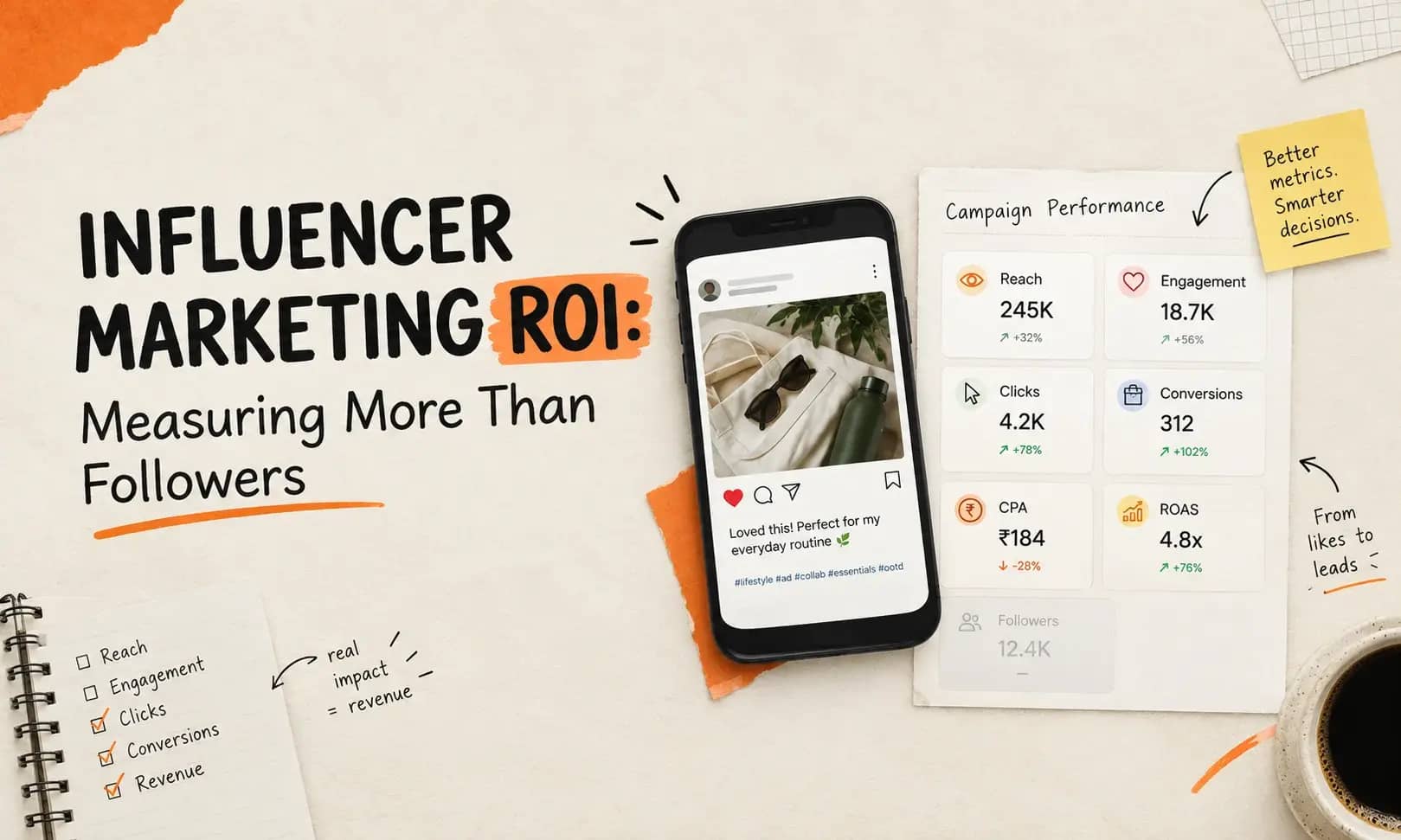
A brand runs a campaign with a creator who has 500,000 followers, gets 40,000 views, three comments, and zero measurable sales – and the debrief conversation somehow still starts with “but the reach was great.” Follower count has become the easiest number to report and, for most D2C and consumer brands, the least useful one for calculating actual Influencer Marketing ROI.
Short answer: Follower count measures potential audience size, not actual influence over a purchase decision. The metrics that predict real Influencer Marketing ROI are engagement rate relative to that creator’s own baseline (not an industry average), audience-to-brand-fit (does this creator’s actual audience overlap with your buyer, not just their stated niche), and – the one almost nobody tracks properly – attributable action: trackable clicks, unique promo code redemptions, or measurable lift in branded search after the content goes live. Getting these three signals right is really the entire difference between guessing at Influencer Marketing ROI and actually measuring it.
Why follower count is the wrong primary metric
Followers are a vanity-adjacent number for two structural reasons. First, a meaningful share of any creator’s following is inactive, bot-inflated, or simply disengaged. A creator can have genuine reach far smaller than their follower count suggests, and there’s no way to know the gap from the follower number alone. Second, and more importantly, follower count says nothing about whether that specific audience is your buyer. A beauty creator with 800,000 followers whose actual audience skews heavily toward a demographic that doesn’t match your product’s price point or use case can underperform a niche creator with 40,000 highly relevant followers, every time, on actual conversion.
The Metrics That Actually Predict Influencer Marketing ROI
Engagement rate relative to the creator’s own historical baseline. A creator averaging 8% engagement suddenly posting your content at 2% is a signal either the content didn’t land with their audience, or the placement (a paid partnership tag, an obviously scripted read) reduced authenticity. Compare against that specific creator’s own history, not a generic industry-wide engagement benchmark, since baseline engagement varies enormously by niche, platform, and audience size tier.
Audience-brand fit, checked directly. Before booking, review the creator’s actual audience demographics (available through most platforms’ creator/business tools) against your buyer profile age range, location concentration, gender split, and stated interests. A mismatch here is the single most common reason a seemingly well-performing campaign (good views, good engagement) fails to move actual sales.
Trackable attribution mechanisms, set up before the campaign, not after. Unique promo codes per creator, UTM-tagged links (even when a platform makes links inconvenient a link-in-bio tool solves this), and, for larger campaigns, branded search lift measured before/after the campaign window. Without these in place from day one, “did this work” becomes a subjective conversation instead of a data one.
Content performance beyond the sponsored post itself. Saves and shares are frequently stronger purchase-intent signals than likes, because they represent a viewer choosing to revisit or pass along the content rather than a passive tap. A campaign with modest views but a high save-to-view ratio often outperforms a high-view, low-save campaign on actual downstream conversion.
Cost per genuinely engaged view, not cost per view. Dividing spend by raw view count treats a 1-second scroll-past the same as a full watch-through with a comment. Where the platform allows it, use average watch time or completion rate to weight the view count before calculating cost efficiency.
A practical measurement framework
| Layer | What to track | What it tells you |
| Pre-campaign | Creator’s historical engagement rate, audience demographic overlap with buyer profile | Whether this creator is a good fit before spending anything |
| During campaign | Unique promo code usage, UTM-tagged click-throughs, saves/shares vs. likes ratio | Real-time signal of whether content is resonating and driving action |
| Post-campaign (immediate) | Attributed sales/leads via promo code or tracked link, cost per attributed action | Direct ROI on the specific campaign |
| Post-campaign (delayed) | Branded search volume lift, direct traffic lift in the 2–4 weeks following | Brand-awareness value that doesn’t show up in immediate attribution but still matters, especially for higher-consideration purchases |
Why some genuinely effective influencer campaigns look “bad” on immediate metrics
Awareness-stage influencer content a creator introducing a new product category to an audience that’s never heard of the brand often shows a modest immediate attribution number and a real, measurable branded-search or direct-traffic lift over the following weeks. Judging that campaign only on immediate promo code redemptions undercounts its actual value. This is why tracking delayed brand-lift signals matters as much as immediate attribution, particularly for newer brands or considered-purchase categories where a single touchpoint rarely closes a sale on its own.
Mistakes that make influencer ROI look worse or better than it actually is
Booking based on follower count alone, without checking audience fit. This is the single most common and most expensive mistake: a large, mismatched audience produces impressive-looking reach numbers and disappointing sales, every time.
Not setting up unique tracking per creator before the campaign launches. Retroactively trying to figure out which creator drove which sale is close to impossible once multiple creators have posted in the same window the tracking has to exist from day one.
Comparing engagement rate across creators of very different follower-count tiers as if it’s the same metric. Engagement rate naturally declines as follower count grows (a structural pattern across nearly every platform), so comparing a mega-influencer’s 2% engagement unfavourably against a micro-influencer’s 8% without accounting for tier is a flawed comparison.
Treating one campaign as a verdict on “does influencer marketing work” for the brand. Creator-audience fit, content format, and offer all vary campaign to campaign; a single underperforming campaign often reflects one of those specific variables, not a category-wide judgment on influencer marketing as a channel.
When to bring in dedicated influencer strategy support
DIY influencer outreach works reasonably well at a small scale with a handful of creators, manageable relationships, and direct tracking. It becomes worth dedicated support once campaigns scale to enough creators simultaneously that manual tracking, negotiation, and audience-fit vetting stop being sustainable as a side task, or when a brand needs to move beyond gut-feel creator selection toward a genuinely data-driven vetting and measurement process..
FAQs
Not irrelevant, but insufficient on its own it indicates potential reach, not actual engaged, relevant audience, which is why it should never be the sole or primary selection criterion.
Unique promo codes per creator and simple UTM-tagged links (using a link-in-bio tool where a platform restricts direct links) provide reliable, low-cost attribution without requiring advanced analytics infrastructure.
This varies enormously by follower-count tier, niche, and platform; comparing a creator only against their own historical baseline is more reliable than benchmarking against a single industry-wide number.
Neither is universally better; it depends on the campaign goal. Micro-influencers often show stronger audience-fit and engagement per rupee for niche or considered-purchase products; macro-influencers can be more efficient for broad awareness plays.
A 2–4 week post-campaign window is a reasonable starting point for measuring branded search or direct-traffic lift, though the right window varies by purchase consideration length and category.