Google Ads Cost India 2026: What the Benchmarks Actually Tell You
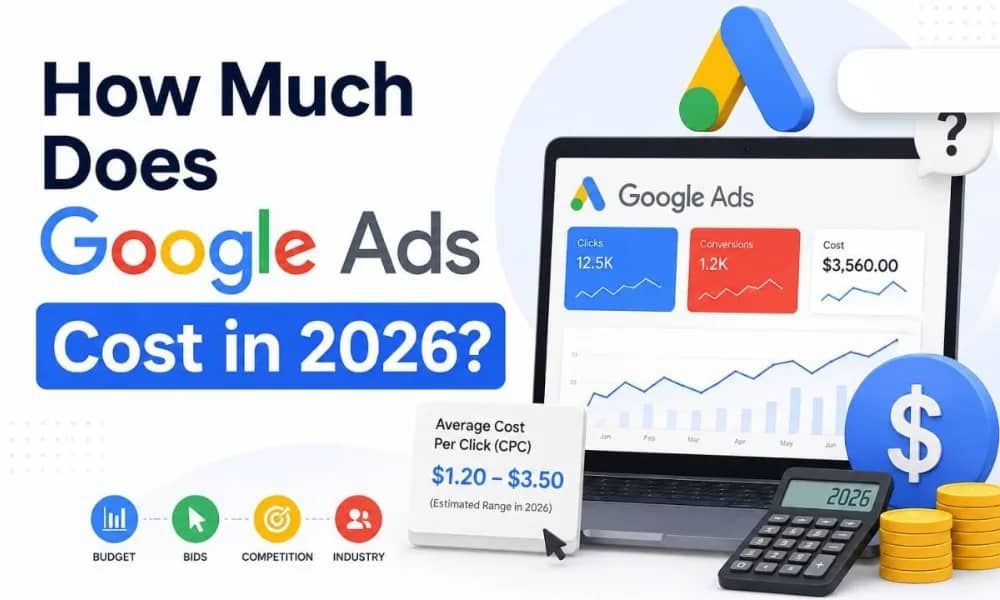
Search “Google Ads CPC India 2026″ and you’ll find a dozen agency blogs, each confidently citing a different average – one says ₹24, another says ₹8-25, another says the range runs from ₹3 to ₹3,000+. They can’t all be precisely right, and the honest reason why is that there is no single official, publicly published figure for Google Ads cost India – Google doesn’t release one, and every third-party number is an estimate built from a different sample, a different mix of industries, and a different point in an auction that changes by the hour.
Don’t budget around a national average. It’s close to meaningless for planning a specific campaign. What’s consistent across every credible source is the shape of the market: Google Ads cost India sits far below US/UK equivalents (commonly cited as 60-85% lower), the spread between cheap and expensive categories is enormous (a 30-100x difference between the lowest and highest-cost verticals isn’t unusual), and the categories at the expensive end are consistently the same – finance, insurance, legal, real estate, and B2B SaaS with high customer lifetime value.
Why the “average CPC” number you find online can’t be trusted at face value
Google Ads runs a live, real-time auction. The price of a click depends on how many advertisers are bidding for that exact keyword, at that exact moment, in that exact location, adjusted by each advertiser’s Quality Score. There is no fixed rate for Google Ads cost India – there’s a price discovered fresh every time someone searches. Any published average is a snapshot from someone’s specific account or keyword sample, generalised to sound universal. That’s genuinely useful directionally, and genuinely misleading if treated as a quote you can plan a budget around.
What’s consistent enough across sources to trust directionally
Finance, insurance, and legal sit at the top of the range, consistently, across every source. These are the categories where a single converted customer is worth enough (a life insurance policy, a legal retainer, a loan) that advertisers can afford to bid aggressively, pushing CPCs well above most other categories, sometimes by an order of magnitude.
E-commerce and local services sit toward the lower-to-middle of the range, consistently. Lower customer lifetime value per click and higher competition-adjusted volume keep these categories more affordable to test and scale.
Real estate and EdTech CPCs have been rising over the past several years, as more well-funded competitors enter both categories and bid more aggressively, a trend worth planning for even without a precise current figure.
Indian CPCs remain substantially cheaper than equivalent US/UK searches, commonly cited in the range of 60–85% lower, which is one of the more consistently repeated (if imprecisely sourced) claims across the market.
A directional framework instead of a false-precision number
| Tier | Typical categories | What drives it |
| Low-cost | Local services, restaurants, low-ticket e-commerce, basic informational categories | High click volume, low value-per-click, less aggressive bidding |
| Mid-cost | Mainstream e-commerce, education, healthcare (general), most B2B services | Moderate competition, moderate value-per-customer |
| High-cost | Real estate, EdTech, B2B SaaS with high contract value | Growing, well-funded competitor base; rising bids |
| Very high-cost | Finance, insurance, legal | Extremely high value per converted customer justifies aggressive per-click bidding |
The only CPC number that should actually drive your budget
Your own Keyword Planner data, pulled for your specific keywords, in your specific target location, checked at the time you’re actually planning the campaign. This is free, takes minutes, and is the only figure that reflects the auction you’re actually entering, not someone else’s account, someone else’s industry mix, or a number published months ago in a market that moves weekly.
A practical way to build a first budget without a trustworthy average
- Pull Keyword Planner estimates for your 15–20 highest-priority keywords, in your actual target geography.
- Build a weighted estimate, not a flat average of your highest-volume, most important keywords should carry more weight in your budget math than long-tail terms you’ll spend little on.
- Add a 20–30% buffer for auction volatility CPCs move with seasonality (festive season, year-end B2B budget cycles) and competitor activity, so a static number from today will drift.
- Set your budget by target cost-per-lead, not target CPC. CPC alone doesn’t tell you whether the traffic converter of a cheaper CPC with a poor landing page can produce a more expensive lead than a pricier CPC with a well-matched page.
- Reassess monthly for the first quarter, then quarterly once the account stabilises Indian CPCs in competitive categories have shown a meaningful upward trend over recent years, and budgets set once and never revisited tend to underperform their own potential.
Mistakes this “average CPC” confusion causes
Setting a budget based on a number from a different industry entirely. A ₹24 average from an e-commerce-heavy sample means little to a business in insurance or B2B SaaS, where the real number can be many multiples higher.
Assuming a low CPC automatically means efficient spend. A cheap click that doesn’t convert is more expensive, per lead, than an expensive click that does. CPC is an input to cost-per-lead, not the metric that actually matters.
Panicking at month-over-month CPC increases without checking Quality Score first. Rising CPCs are sometimes a genuine market shift and sometimes a fixable ad relevance or landing page issue checking Quality Score before assuming the whole category got more expensive can save significant budgets.
When to bring in professional media planning
Building an accurate, defensible budget forecast based on your specific keyword set, category, and realistic conversion assumptions – rather than a borrowed industry average – is genuinely one of the higher-value early conversations to have with a paid media specialist, precisely because the public numbers around Google Ads cost India are this unreliable. Getting the initial budget assumption wrong by even 2x, in either direction, either starves a campaign of the volume it needs to learn or burns spend on an inflated forecast that was never realistic.
FAQs
There’s no single trustworthy figure published estimates vary widely (commonly cited ranges span roughly ₹5 to ₹150+ depending on industry, with some high-value categories going well beyond that). Your own Keyword Planner data for your specific keywords and location is more reliable than any published average.
Finance, insurance, legal, and B2B SaaS with high customer value consistently sit at the top of the range across most published benchmarks, driven by high value per converted customer.
Multiple sources point to a rising trend in competitive categories like real estate, BFSI, and EdTech over recent years, as more funded competitors enter and bid more aggressively though the exact pace varies by source and isn’t independently verifiable from a single authoritative figure.
Commonly cited estimates place Indian CPCs 60–85% below equivalent US search terms, though this varies by category and keyword.
Use it only as a rough sanity check, not a planning input to pull your own Keyword Planner estimates for your specific keywords and geography before setting a real budget.